Showing posts sorted by relevance for query dried apple. Sort by date Show all posts

Friday, October 22, 2021

An Apple Bee


I recently attended a fantastic program on apple diversity hosted by Eleanor Jenkins' Uplands Apple Farm in Eaton NH, led by Jared Kane, Executive Director, Branch Hill Farm Preservation Orchard, Milton Mills, NH with support from Catherine Dufault, District Manager, Carroll County Conservation District in Conway NH. 

It was not quite the raucous crowd depicted in a print by Winslow Homer below (more on that later).  
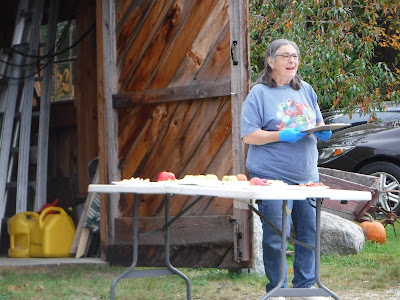

After a welcome and history of the orchard from Eleanor, Jared explained the history and taste profiles of each variety as we passed the plates around ...


... and enjoyed the beautiful views with heirloom apple trees planted all along the stone walls.  We tried over fifteen varieties of apples (for our previous blog on Ashmead's Kernel follow this link here). 


We were able to compare the taste with the unique look of the apples side by side. The chalk board in the cider room indicated it was a pretty good harvest this year. 


The numbers next to the apple variety names indicates the number of bushels harvested. For more on this year's harvest and local apple history see this issue of the Conway Daily Sun here. 

Now to the Winslow Homer print I mentioned above. It was published in Harper's Weekly Magazine in 1859. For more info on the print itself in various museum collections see these links here. 


The title Fall Games - The Apple-Bee can be seen at the bottom of the print (click on images to enlarge them). 

During the period the term "bee" referred to a social activity where work and play were combined. Other examples are the quilting bee, husking bee and scutching bee. Think of the insect bees and how they dance while they work. 

The print includes numerous vignettes that provide several sets of interesting comparisons and contrasts to explore. 
 
Let's start with the top of the image. Hung along the ceiling are several strings of sliced apples drying over the fireplace. 


Drying apples preserved food calories in a time before refrigeration. Today we can get fresh apples from around the globe any time of the year. They could not. 
 
Dried apple slices were (and are) a tasty snack that could be enjoyed as well as the main ingredient in New England's famous dried apple pie (for breakfast with sharp cheddar cheese). For our previous blogs on that tradition see these links here and here. 

On the left section of the print a young man demonstrates an example of technological innovation to a group of older folks who look on attentively and somewhat bemused. 


This machine peels and cores at the same time resulting in both labor saving and an increase in productivity. Notice the pile of processed apples on the table. You can still purchase essentially the same design today. 


Here is a copy of an ad from 1895. 


Also note the "White Mountain" potato parer (click on images to enlarge them). 

They were made in a wide variety of styles. We have a number of versions in the collection of the Conway Historical Society. For more on the topic see the Virtual Apple Parer Museum here. 

On the right of the print can be seen the more traditional hand peeling method. 


Speed and productivity do not seem to be the main concern of the young couple depicted here. They may be more interested in the lingering and longing of courting. Compare the the pile of apples yet to do at their feet with the processed pile seen before. Also note the successful courting of the couples in the back ground behind them. 

More romance can be seen in the central figure...  


... who tosses an apple peel over her shoulder with the belief that it will spell out the initials of person she is destined to marry. For more on this tradition see the links here and here. 


Seen below the young man working the mechanical peeler/parer (and the old folks watching him work) are a pair of children playing with a carved pumpkin.  

Almost obscured in the background is a liquid contrast to the solid examples of apple products. This vignette is but a small portion of the print, however, as Jared explained during the program, this apple product played the largest role in the actual history of apples in this country before the 18th Amendment to the U.S. Constitution (Prohibition). 


A nicely dressed older gentleman raises a glass of cider poured from a barrel seen over his left shoulder. Jared explained that "cider" refers specifically to the alcoholic drink and therefore the term hard cider is redundant. 

David Tatham here (p. 87) points out how unique this print is in Homer's body of work. He argues that "Nothing in his work as a painter remotely recalls the electric, hot-blooded relations among young men and women that he recorded with such evident relish in these country frolics. In hardly any other of his drawings for the pictorial press did he depict such free and unselfconscious displays of emotion between individuals." 

For a taste of more on the autumn harvest see our current display at the Conway Public Library and its related blog here. 

To further explore this and many other historical topics, we offer free outreach programs to local schools and community groups. We can also provide programs via zoom. Please contact us at the Conway Public Library's Henney History Room for more information.

Wednesday, June 5, 2019

New England Flavor

A dried apple pie with sharp cheddar cheese for breakfast is a great traditional New England way to celebrate National Dairy Month. 


In his 1956 Country Flavor Cookbook at the Conway Public Library's Henney History Room, Haydn Sanborn Pearson explains "that cheese, melted, does something to an apple pie that is wonderfully salubrious." You can see more about this book in a previous blog at this link. 

There are many opinions, but few facts about this New England's tradition. There is a saying up here that “an apple pie without the cheese is like a kiss without the squeeze.” I grew up in the south where we would not consider putting cheese on apple pie, but we would put cheese on grits (more on grits in a future blog).

While this pairing of apples and cheese can not bring geographical regions together, it does bring together the sweet and the savory. It also brings together different seasons of the year, bridging the past with the present. 

In his 1966 book, The New England Year, (also in the collection of the Conway Public Library's Henney History Room), Pearson explains how the apples were dried in the Autumn.


Strings of sliced apples can be seen hanging above the fireplace in a Winslow Homer print from Harper's Weekly magazine depicting an Apple-Bee. See this link.

I have always been fascinated with food preservation before refrigeration and the many ways the harvest of the past is preserved for the future. A dried apple pie with cheese is a masterpiece of food preservation.

Cheese is made from milk. There is a quite a bit of science to preserving milk through making cheese. In the process, the milk in cheese becomes something completely unlike milk, but cheese has its own interesting and delicious properties. Cheese-making is a long and involved process that makes use of bacteria, enzymes and naturally formed acids to solidify milk proteins and fat and preserve them. Once turned into cheese, milk can be stored for months or years.

The main preservatives that give cheese its longevity are salt and acids. The basic steps in cheese making go something like this (for most common cheeses like cheddar): First, milk is inoculated with lactic acid bacteria and rennet. The lactic acid bacteria convert the sugar in milk (lactose) to lactic acid. The rennet contains enzymes that modify proteins in milk. Specifically, rennet contains rennin, an enzyme that converts a common protein in milk called caseinogen into casein, which does not dissolve in water. The casein precipitates out as a gel-like substance that we see it as curd. The casein gel also captures most of the fat and calcium from the milk. So the lactic acid and the rennet cause the milk to curdle, separating into curds (the milk solids, fats, proteins, etc.) and whey (mostly water). A gallon of milk (about 8 pounds) yields only about 1.25 pounds of cheese -- the weight that is lost is all the water in milk.

The curds and whey are allowed to soak until the lactic acid bacteria create a lactic acid concentration that is just right. At that point, the whey is drained off and salt is added.

Now the curds are pressed in a cheese press -- lightly at first to allow the escape of the remaining whey, then severely (up to a ton of pressure) to solidify the cheese.

Finally, the cheese is allowed to age (ripen) for several months in a cool place to improve its taste and consistency. A sharp cheddar cheese has been aged a year or more. During this time, enzymes and bacteria continue to modify proteins, fats and sugars in the cheese.

There is also a lot of math to milk. Farmers had to be acquainted with the phases of a cow's life and calculate seasonal strategies. Before cows could give milk, she had to give birth. This is called "freshening." Cows can then be milked for 305 days or about 10 months. Then the cow's body needs to rest and store nutrients before she can be bred again and nine months before she has her next calf.

She's generally allowed to "dry" about seven months into her pregnancy. By that time, her milk production is lower, so drying usually consists of cutting back on milking and the amount of grain fed. When she stops producing milk, dairy farmers continue feeding her large quantities of hay or keep her on pasture. Allowing a two-month dry period before her next calving lets her mammary glands rest and prepare for the new baby and subsequent freshening… and that is just the tip of the iceberg.

With the Fall harvest preserved and summer's best cheese aged anywhere from two to twenty years.

Pearson goes on to explain...


"nothing complicated?" I have never read such a detailed yet poetic receipe that implies the need for a ruler to get the proper depth of the pie. The re-hydrated apples have a certain texture and chew to them, that makes each bite burst like gummy bears. 

Pearson's books are full of country wisdom. The book jacket of The New England Year shows activities of each season and includes biographical information on the author (click on images to enlarge them).


In future blogs we will explore other aspects of National Dairy Month and learn how to date a cow. I will end this blog Here is the parting shot for this blog The parting shot for this blog can be followed at this link.. but that is a whole another can of worms. 

Thursday, October 14, 2021

Fall for Autumn


Our current display greeting you as you enter the Conway Public Library focuses on "the art of the autumn harvest" and its seasonal traditions.  The top shelf features the foliage that brings in buses full of visitors during this time of the year. The "centerpiece" of course is a bouquet of autumn colors, a final blaze of glory before the white of winter.

The image featured at the right of the exhibit label is by Maxfield Parrish who was once a NH summer resident. 


It is a self portrait of the artist as Jack Frost, with golden pots of paint to color the leaves all the different tints of autumn. The painting was featured on the cover of Collier's Magazine on October 24th, 1936. The original oil on board is in the collection of the Haggin Museum, Stockton, CA. The library has a number of books on Maxfield Parrish that illustrate his many New Hampshire works and explain in detail his unique approach to art and illustration. 


In the back right hand corner of the shelf is a hand-made corn husk doll. The doll is a good example of the old Yankee thrift ethic embodied in the motto "use it up, wear it out, make do or do without!" Corn husks are one of a number of by-products from harvesting a main crop this time of year. 

Corn cobs are another by-product of harvesting corn and innovative Yankees found ways to make use of those as well. Like any good artwork, this 1864 painting by Eastman Johnson works on a number of different levels. 


A black and white version allows us to examine the details more clearly.  


The image compares work and play, young and old, and the subtleties of silent interaction between the two. 

More information on the painting can be found here. Eastman Johnson had ties to the local area. He was born in nearby Lovell, Maine and grew up and painted in Fryeburg.  

The next shelf down continues to explore many of the same themes. 


On the left is an engraved powder horn. It is a by-product of the butchering process. The powder horn was made from cow horn and used to provide a water proof and spark proof container for gun powder. 

To the right of the powder horn is a small promotional magazine called the New Hampshire Troubadour with a cover showing a hunter with his dog in an autumn setting. 

A similar image is scratched into the horn itself. 


Above is the hunter with his rifle. Below is his dog. 


Presumably, the name of the powder horn's owner was Jess? 


... and perhaps he did not even know how to properly spell his own name? This was not uncommon during the period. 


The tip was carved to enable a leather shoulder strap and a wooden stopper to be attached to the powder horn. 


Jack o' lanterns are another carved seasonal artwork. This painting by Norman Rockwell also explores themes seen in the Eastman Johnson painting above such as young and old, work and play.  


The painting was printed in the 1952 Four Seasons Calendar published by Brown and Bigelow. A charcoal on paper study for the painting is in the collection of the Hofstra University Museum and helps us explore the relationship between a study and a finished work of art. You can learn more about that here.


The tin object shaped like a rocket ship on the right of the shelf is actually a sausage stuffer. 


It is missing it's wooden plunger. It works like a large hypodermic needle. While the cow horn is a by-product, the main purpose of fall butchering was to harvest the meat. 

Reasons for butchering in the fall include not having to feed as many livestock over the winter and the cold weather helps in the preservation process. Making sausage allows one to combine meats, spices, even apples, improving the taste to one's liking and then by smoking the sausage it can be preserved over the winter. 

In front of the sausage stuffer is a scoop made from cow horn. Behind the sausage stuffer is a photo of a corn maze. Farmers of the past would be amazed that today we pay good money to walk through a corn field. To them they only did that as part of their work. 

The next shelf down features more seasonally popular produce. On the left is a dipper made from a dried gourd.  


Behind and to the left of the gourd is a 1950s era Coca-Cola ad illustrating the game of snap apple. 


Here is an earlier depiction of a snap apple party from 1845. 


For more information on this painting follow this link here.

The apple theme is continued on the right hand side of the shelf with Winslow Homer's 1859 print Fall Games - The Apple Bee. 


Published in the November 26, 1859 edition of Harper's Weekly, this print features vignettes illustrating the role of apples in romance, technological change, alcoholism, and supernatural divination. For more information on this print see this link here. 


While this painting by William Sidney Mount may seem to only be a convincingly captured common moment in rural life, it actually has an interesting background as political propaganda. For more info on this painting see this link here. 


The chapter on "The Doughnuts" in this book from my childhood has now became part of our fall family traditions. 


A similar machine can be found at the White Mountain Cider Company in Glen, New Hampshire. 


The bottom shelf focuses on flax and linen. 


A number of tools and techniques used to process flax into linen can be seen in this painting from 1885 entitled Flax Scutching Bee at the National Gallery of Art. For more info on this painting see this link here. 


For more on flax see our previous blog here. 

We will leave you with this lethal looking device is a heckle, or hackle used in processing the flax plant to linen. 


We have only touched on the tip of a tall stalk (metaphorically speaking). 

To further explore this and many other historical topics, we offer a free outreach program to local schools and community groups. We can also provide a program via zoom. Please contact us at the Conway Public Library's Henney History Room for more information. 

Did you get the point? 


Tuesday, December 20, 2022

Carp in the bathtub and Hoppin' John for the Holidays


Are you familiar with these traditional culinary holiday delights? Let me tell you some holiday stories from our extended family. 

Carp in the Bathtub is a popular Slavic holiday experience that was carried over from our family ancestors in central Europe to Chicago and celebrated by our Jewish, Catholic and Baptist relatives there. 


The story is told in a wonderful children's book that harkins back to an earlier era, before refrigeration, in which live carp in the bathtub provided fresh fish for the holiday.  


In some cases served as a delightful twelve course meal. 

We also enjoy the more mainstream, mid-western traditions from our Ohio family members of turkey and ham and green bean casserole with Campbell's cream of mushroom soup.

The tradition of Hoppin' John on New Year's Eve comes from our southern kin. 


Hoppin' John goes great with collards and corn bread or hushpuppies, or both!

A newer family tradition, Iskender, comes from some of our travels.  


Others countries represented in our extended family holiday celebrations include dishes from Panama, the Netherlands, and now New England (although our New England roots go back many generations) such as red flannel hash and dried apple pie topped with a thick slab of sharp cheddar cheese. 

Each of these different tastes unlocks involuntary memories containing the "essence of the past" as described by Proust in Remembrance of Things Past. 
 
For recipes contact us at the Conway Public Library's Henney History Room. 

For more on your own family history and maybe some forgotten traditions you would like to revive contact us at the Conway Public Library's Henney History Room. We offer free guidance and workshops on researching, preserving and sharing your family history and traditions. 

Have a very merry holiday and a happy New Year!