Wednesday, February 2, 2022

Candlemas: Superstition, Science and Art

As I write this...


... a storm is brewing.
 
However, it felt like a warm spring day when I walked up the stairs to work this morning. The temperature will swing from its current balmy 37 degrees down to minus 10 Saturday night. The skies will range from today's clear haint porch blue (a reference to a superstition - more on that later) to cloudy and overcast, to rain, to snow, and ice - all in the next four days. We will soon have our second nor'easter in as many weeks. 

This morning a furry rodent saw his shadow and forecast six more weeks of winter. 

Naturally, I thought of Samuel Lancaster Gerry's 1855 painting The Snow Line, Mount Washington, New Hampshire in the collection of the North Carolina Museum of Art. (FMI and to use their nice online zoom feature see this link here). 

You can divide the painting in half to watch the progress of the coming storm. 

On the right, you can see gray and pink clouds and patches of ultramarine and baby blue sky. Below that, you can see a man holding a staff with his ever watchful dog standing by. Presumably they are herding the cows that follow a line towards the water. Silhouetted on the ridge to the right is the last straggling cow and a man on horseback who brings up the rear of the herd.  

The left side of the painting shows the dark storm clouds coming in, the frosted branches of the trees, and the billowing, wind-whipped, puffs of snow. 

In the middle ground are the stark profiles of rocky ledges and beyond that in the distance the summit of Mount Washington, the tallest mountain peak in New England. 
 
In the photo below you can see the fascinating phenomenon of rime ice on the summit.  These feathery fronds of ice actually form into the wind which approaches from the left in the photo. 
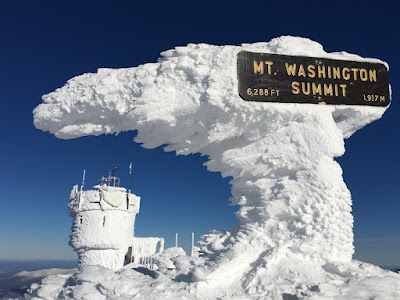

With facilities like the observatory we have come a long way in weather monitoring and forecasting. FMI see this link here.
 
Winter on Washington has been a subject of interest for over 150 years, since the first over winter expedition of 1870-1871.  

In fact these frost feathers (rime ice) were featured in an illustration from the book that documented the expedition (facing p. 286). You can read it online here or see it for yourself in the Conway Public Library's Henney History Room here


The cover of the book celebrates the cog railway which still operates today (FMI see this link here). 


FMI see our previous blog here

In the following illustrations you can see some of the period meteorological instruments.  


One member of the party was a photographer and he created a series of stereoviews from the expedition. FMI see our previous blog here

While rare, there are a number of other winter related White Mountain paintings. You can see more of them at this link here

While the focus of these paintings is on the overall beauty of the landscape, they often capture little details showing activities of the period. 

Can you see the horse logging operation? 


and oxen below...


...farmers driving their livestock...


Look at the details included here to see the frozen laundry hanging on the line. 

However, it was not all work. There was also fun, such as ice skating...


... and magic. Maxfield Parrish was able to capture the essence of a winter twilight.  


Winslow Homer's dusky sleighing scene below is almost an abstract painting.  


We have several paintings on display in the Conway Public Library's History Hall.
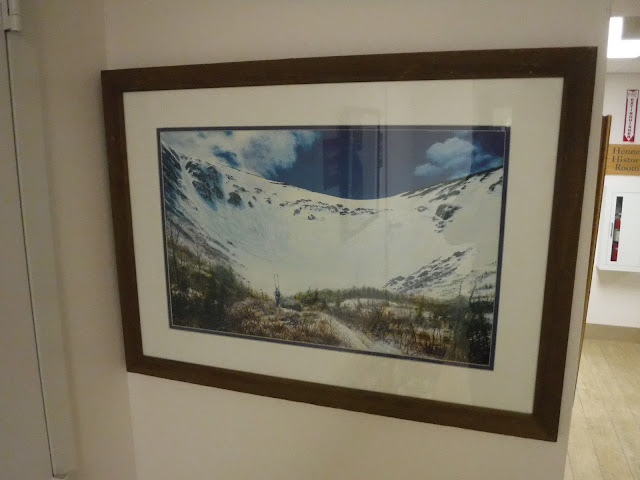

Tuckerman's Ravine is a popular ski spot that can be skied well into the Spring. As there are no lifts here, one must hike up to nail that experience. 


Here are some of the routes skied in the ravine. 


Winslow Homer was adept at capturing evocative slices of life in his illustrations.  The period from about 1300 to 1850 was known at "the little ice age" and you can see that in this picture. 


In a future blog we will look at ways in which they kept themselves warm during the winter, what they ate, and how (besides a superstitious folktale about a groundhog) they forecast and prepared for the weather. 

To gain an intimate understanding of our New England winters, the Chocorua Lake Conservancy is hosting a Winter Camping Expo, on Saturday, February 12. FMI see this link here and here
 
Dedicated winter campers Geoff Burke, Dave Evans, and Sheldon Perry will share what they’ve learned about winter camping, trekking, and seasonal trapping and hunting, and offer a show and tell of traditional heated tents and trekking toboggans. Hot drinks and warm soups will be available around the campfire. Come when you like and enjoy the company of friends and neighbors out-of-doors, ask questions, and share your own winter camping stories.

For more information on this and other local history subjects contact us at the Conway Public Library's Henney History Room.

Wednesday, January 5, 2022

Frosty Woods


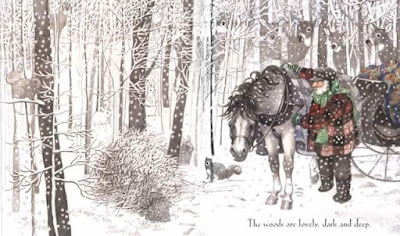
Recently a friend posted the illustration above by Susan Jeffers from a children's book on Robert Frost's poem along with the following on Facebook: “Three years ago this week, Frost’s poem “Stopping by the Woods on a Snowy Evening” became public domain. That poem is ours now. So, tonight, drop me your favorite line or stanza from Frost and what it means to your life.”

My reply focuses on the opening two lines: 

Whose woods these are I think I know.
His house is in the village though;

The opening lines of this poem naturally make me think about traditional New England vernacular land use patterns and farming practices. Isn't it the same for you? 

It raises the question, why would his house be separate from his woods? To address this enigma, we will turn to art, cartography, geology, ...  and of course lasers. 

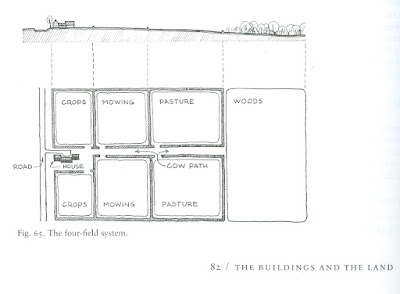
Historically, to make the best use of the land a typical early New England farmer would own a variety of lots in different areas of a town. The best place for a sugar bush may not be a good place to pasture cows, or plant an orchard, or build a home, so depending on topography, soil types, elevation and so on different lots in different parts of town would serve different purposes. 

The land was organized by function - dooryard, barnyard, garden, crop fields, hay lots, pasture, and of course the woodlot. The paths connecting them were controlled by wood fences, gates, sheep dogs and stone walls. For our previous blog on reading stone walls from the ground and with lasers see this link here

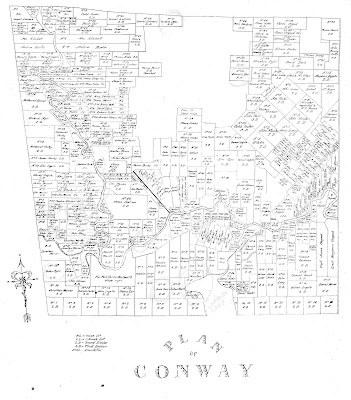
These lot patterns can be seen in an early map of Conway on display at the Conway Public Library. 


A closer look at another version of that map shows that the Town founders adapted the size and shape of the lots to the land (click on images to enlarge them). 


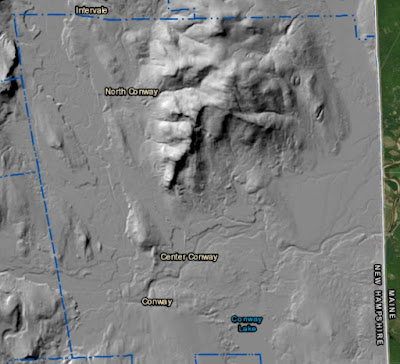
Here is a laser produced relief map known as LIDAR that shows the underlying topography of the town. 


For example, the Cranmore Mountain area can be seen as a large blank spot. This was not assigned to any specific person but was instead considered common land. The lots in the flat fertile areas and along the low hills of town are large. The lots along the rivers are smaller, long and narrow to allow the greatest number of farmers to have their livestock have access to water. 


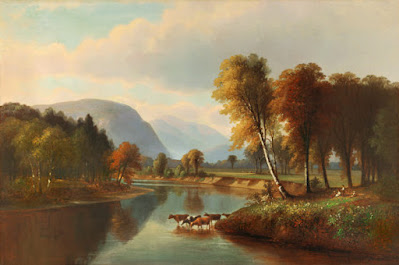
White Mountains artists captured scenes of livestock drinking from the Saco River in Conway, a practice that would not be allowed today.  You can see a number of them here

In his book, Big House, Little House, Back House, Barn, Thomas Hubka provides a great detailed explanation of these traditional field patterns. 


In his 1792 History of New Hampshire, Jeremy Belknap provided a "how to" manual for pioneers. He explains the kinds of soils that can be found under different types of trees and how that particular soil should be prepared there and what kinds of crops grow best in those soils. It also details the kinds of products that can be made from different trees and plants. 

Back to the children's book. I have always loved this edition of Robert Frost's poetry. You can check out this book with illustrations by Susan Jeffers at the Library as well as many other books she illustrated. 

For more information on this or any other Mount Washington Valley topic contact us at the Conway Public Library's Henney History Room.

Wednesday, November 24, 2021

Happy Thanksgiving 2021


We will be sharing our New Hampshire Thanksgiving virtually this year with friends and family in Florida, Virginia and the Netherlands. This is an historically interesting coincidence as all these seemingly disparate places also happen to play important roles in the Thanksgiving story. 


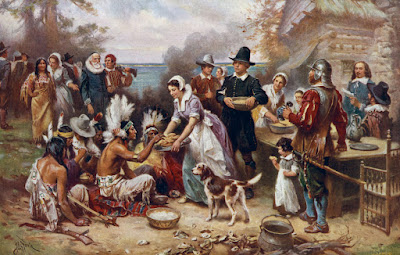
Many people imagine a scene like that above when they think of the first Thanksgiving said to be held in 1621 in Massachusetts. For more on this painting see the link here

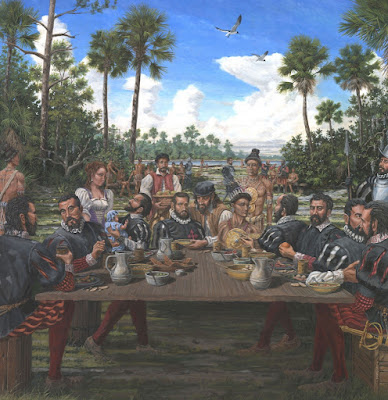
However, an earlier Thanksgiving in Florida in 1565 may have looked more like that below with Spanish Conquistadors, top-knotted Timucuans, longleaf pine and sabal palm trees (they may have even eaten part of the palm tree).  


For more on this argument see these links here and here. Instead of turkey, this thanksgiving would have more likely included gopher tortoise, mullet and gator.  


See our previous blog on a beast feast in Maine here


These images are from a book published in 1591.  


Another possible entree was Cocido-Madrileno, a stew made from salted pork and garbanzo beans laced with garlic seasoning.  


Even in Florida however, we were taught the Pilgrim version of the holiday in elementary school. 


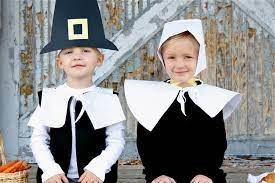
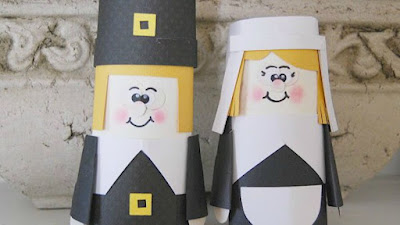
We had pilgrim pageants with construction paper costumes and played "colonial" games. Even if made from toilet paper rolls, these images are iconic and easily recognizable, but inaccurate and incomplete.  

 
In Florida we used the extra large cones of the Longleaf Pine to make decorative turkeys...


... complete with crayon outlined hand silhouettes for their tail feathers. 

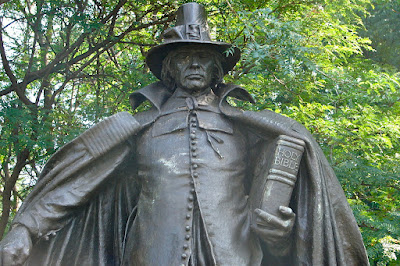
The famous sculpture below shows a Pilgrim with a "buckle hat." 


In fact, the buckle hat was fictional. Pilgrims never wore such an item, nor has any such hat ever existed as a serious piece of apparel. The sculpture was created by Augustus St. Gaudens in 1904. St. Gaudens summered in Cornish New Hampshire. FMI see this link here

The pilgrim buckle hat is featured on signs for the Massachusetts turnpike. 


This earlier controversial sign seen below has been retired. 


Now for the Dutch connection (everyone say hello to Julia and Joost). The Pilgrim Mayflower trail made an important stop in the Netherlands. FMI see these links here and here

Misguided Virginians think the first Thanksgiving was held at Berkeley Plantation. They even built a shrine marking the site. FMI see these links here


Finally for the important New Hampshire connection during the 19th century. 


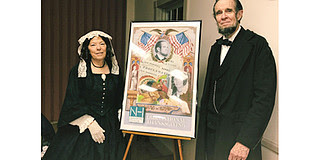
Pictured here are reenactors Sharon and Steve Wood playing Sarah Josepha Hale and Abraham Lincoln. See this link here for more details about their NH Humanities program. 

While I think we should all learn more about history from different perspectives, I echo Eric Meltzer's column in today's Conway Daily Sun (see link to his article here) in which he points out the problems with the Mass pike signs illustrated above. 

This is a holiday in which we can enjoy a couple days off work and focus on food, parade, friends and family. It has a much less commercial nature to it than many other holidays. 

By the way "wheels," my first car was a Plymouth Fury I got from my Grandfather.  

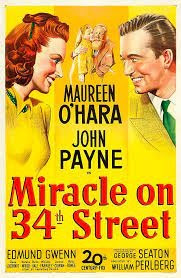
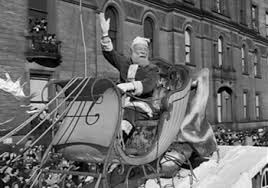
So, we will continue to do what we did in Florida, Delaware, Indiana and now New Hampshire. Our family tradition starts with breakfast and the Macy's Parade. Then after dinner, we will watch The Miracle 34th Street


FMI on the film see link here

Our family Christmas holiday does not officially begin until we see Santa at the end of the parade in the film. 


On Black Friday (or Plaid Friday as some are now calling it), I will be presenting a program about the history of Thanksgiving for a local community group. I would be happy to do a free outreach program for other local schools and community groups as part of our seasonal "art of the harvest" programs. If you are interested in learning more contact us at the Conway Public Library's Henney History Room. 
Wednesday, November 10, 2021

This Revolutionary Event Was A Real Blast!


Posted in honor of Veterans Day and to prepare for future events.  

We recently attended a commemorative event at a Conway cemetery honoring a local veteran of the American Revolution that included this musket salute by a color guard in period costume.  

After five years of research, with help from The Sons of the American Revolution, The Daughters of the American Revolution and other local historians, the family was able to earn several memorial plaques for this veteran's grave.


The family wrote, "The Henny History Room held many documents that allowed us information to assist us, in our research of this lost patriot and for that we will always be grateful. We appreciate all the times you patiently dug out volumes, pulled files and maps and assisted us with the tasks at hand..."

We have also had a couple of other requests for information about the history and service of other local soldiers from the colonial and revolutionary war eras. 

It was a stirring ceremony and we hope to see many more patriotic events like this as we near the 250th anniversary of the Declaration of Independence in 2026 (only five years away). See our previous blog on that subject here

We have been reviewing our local online newspaper archive for how the Bicentennial of the Declaration of Independence was celebrated in Conway in 1976 (fifty years ago) and have found many examples to be followed. You can read some of the exciting things they did then at this link here

We are planning to offer free outreach programs on colonial and revolutionary period history to local schools and community groups that will include hands-on activities such as writing with a quill pen. 

We are also updating our online data base for cemetery records and as you may know the Conway Historical Society has published a guide with GPS coordinates to all the known cemeteries in town. Some of them are very hard to find. Let me know if you want to purchase your own copy or you can borrow a copy from the library. Of course we also have the library subscription of  the Ancestry software and would be happy to help guide you in your family history research. 

We also offer workshops on how to properly preserve family papers and photos. For more information contact us at the Conway Public Library's Henney History Room.
Sunday, October 31, 2021

Space Oddities and Spirits of the White Mountains

Submitted for your approval...


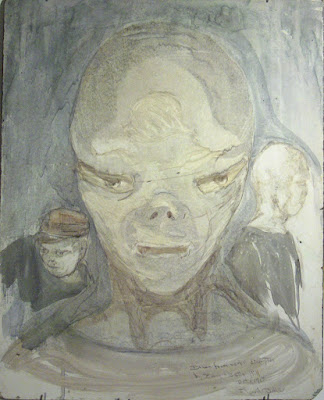
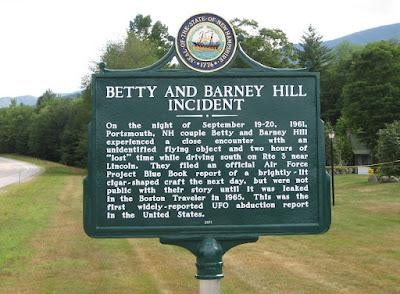
... in the spirit of the season, a painting by local artist David Baker based on a description from alien abductees Betty and Barney Hill. The site of this celebrated event is even documented with a New Hampshire state highway marker. 


For more info on this topic see the link here

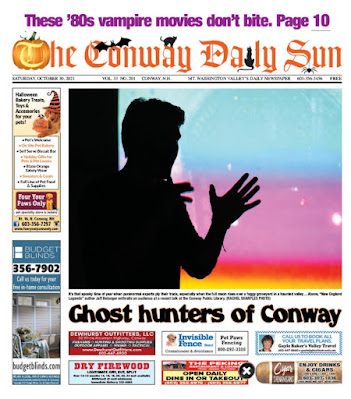
Saturday's Conway Daily Sun featured several recent programs held at the Conway Public Library - Ghost hunters of Conway with Luna Paranormal and Ghost Adventures with Jeff Belanger. 

A search for the word "halloween" in our online collection of The Reporter News here finds over seven hundred results and yields insight into the ways in which the holiday was celebrated in the past.

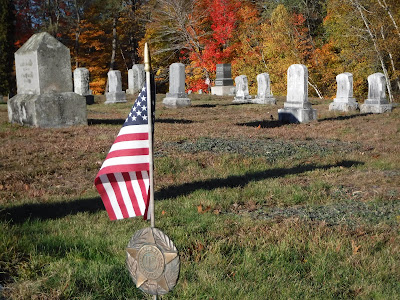
Cemeteries take on a special meaning during this time of the year and recently we had several library patrons looking for the location of their ancestor's graves. 


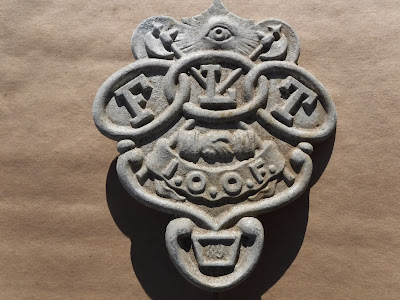
A sense of both beauty and mystery can be found while walking through some of our local cemeteries.  Some of the graves are marked with special medallions. 

A watchful all seeing eye at the top this marker overlooks the initials FLT which stand for friendship, love and truth.  


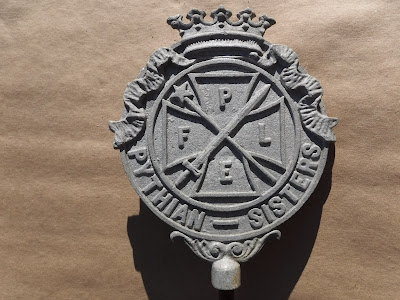
The letters IOOF stand for the Independent Order of Odd Fellows, one of a number of secretive societies such as the Knights of Pythias, Fraternal Order of the Eagles, and the Grand Army of the Republic. 

We use the codes and symbols employed by these groups to help learn more about the history of the people buried beneath the markers in our patron's searches for their family history and genealogy. Can you guess what the one below reveals?  


While cemeteries play a spooky role in October's events, the mood changes in November to a more positive, patriotic role as we will explore in a future blog. 

Have a Happy Halloween and if you want to learn more about any of the topics in this blog contact us at the Conway Public Library's Henney History Room.
Friday, October 22, 2021

An Apple Bee


I recently attended a fantastic program on apple diversity hosted by Eleanor Jenkins' Uplands Apple Farm in Eaton NH, led by Jared Kane, Executive Director, Branch Hill Farm Preservation Orchard, Milton Mills, NH with support from Catherine Dufault, District Manager, Carroll County Conservation District in Conway NH. 

It was not quite the raucous crowd depicted in a print by Winslow Homer below (more on that later).  


After a welcome and history of the orchard from Eleanor, Jared explained the history and taste profiles of each variety as we passed the plates around ...


... and enjoyed the beautiful views with heirloom apple trees planted all along the stone walls.  We tried over fifteen varieties of apples (for our previous blog on Ashmead's Kernel follow this link here). 


We were able to compare the taste with the unique look of the apples side by side. The chalk board in the cider room indicated it was a pretty good harvest this year. 


The numbers next to the apple variety names indicates the number of bushels harvested. For more on this year's harvest and local apple history see this issue of the Conway Daily Sun here

Now to the Winslow Homer print I mentioned above. It was published in Harper's Weekly Magazine in 1859. For more info on the print itself in various museum collections see these links here


The title Fall Games - The Apple-Bee can be seen at the bottom of the print (click on images to enlarge them). 

During the period the term "bee" referred to a social activity where work and play were combined. Other examples are the quilting bee, husking bee and scutching bee. Think of the insect bees and how they dance while they work. 

The print includes numerous vignettes that provide several sets of interesting comparisons and contrasts to explore. 
 
Let's start with the top of the image. Hung along the ceiling are several strings of sliced apples drying over the fireplace. 


Drying apples preserved food calories in a time before refrigeration. Today we can get fresh apples from around the globe any time of the year. They could not. 
 
Dried apple slices were (and are) a tasty snack that could be enjoyed as well as the main ingredient in New England's famous dried apple pie (for breakfast with sharp cheddar cheese). For our previous blogs on that tradition see these links here and here

On the left section of the print a young man demonstrates an example of technological innovation to a group of older folks who look on attentively and somewhat bemused. 


This machine peels and cores at the same time resulting in both labor saving and an increase in productivity. Notice the pile of processed apples on the table. You can still purchase essentially the same design today. 


Here is a copy of an ad from 1895. 


Also note the "White Mountain" potato parer (click on images to enlarge them). 

They were made in a wide variety of styles. We have a number of versions in the collection of the Conway Historical Society. For more on the topic see the Virtual Apple Parer Museum here

On the right of the print can be seen the more traditional hand peeling method. 


Speed and productivity do not seem to be the main concern of the young couple depicted here. They may be more interested in the lingering and longing of courting. Compare the the pile of apples yet to do at their feet with the processed pile seen before. Also note the successful courting of the couples in the back ground behind them. 

More romance can be seen in the central figure...  


... who tosses an apple peel over her shoulder with the belief that it will spell out the initials of person she is destined to marry. For more on this tradition see the links here and here


Seen below the young man working the mechanical peeler/parer (and the old folks watching him work) are a pair of children playing with a carved pumpkin.  

Almost obscured in the background is a liquid contrast to the solid examples of apple products. This vignette is but a small portion of the print, however, as Jared explained during the program, this apple product played the largest role in the actual history of apples in this country before the 18th Amendment to the U.S. Constitution (Prohibition). 


A nicely dressed older gentleman raises a glass of cider poured from a barrel seen over his left shoulder. Jared explained that "cider" refers specifically to the alcoholic drink and therefore the term hard cider is redundant. 

David Tatham here (p. 87) points out how unique this print is in Homer's body of work. He argues that "Nothing in his work as a painter remotely recalls the electric, hot-blooded relations among young men and women that he recorded with such evident relish in these country frolics. In hardly any other of his drawings for the pictorial press did he depict such free and unselfconscious displays of emotion between individuals." 

For a taste of more on the autumn harvest see our current display at the Conway Public Library and its related blog here

To further explore this and many other historical topics, we offer free outreach programs to local schools and community groups. We can also provide programs via zoom. Please contact us at the Conway Public Library's Henney History Room for more information.