Monday, September 23, 2019

Pumpkin Spice is Back!


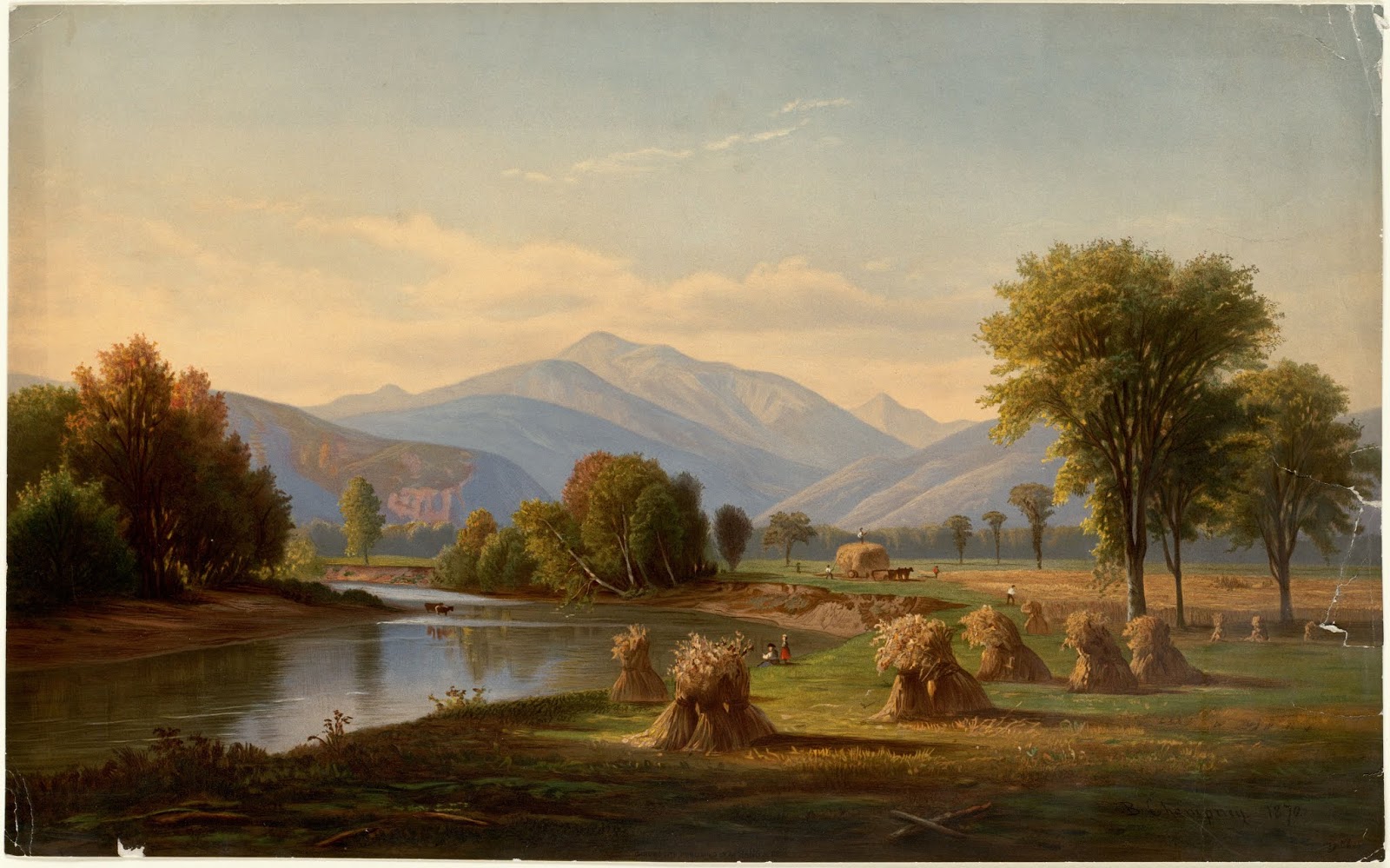
Today is the first official day of autumn and in this blog we will look at iconic images of fall such as this one from 1871 by Benjamin Champney who lived and worked in Conway.

But first, a bit about the official start of the season. The equinox actually occurred at 3:50 am this morning eastern time.

Recently we did an outreach program for the John Fuller Elementary School and mapped the earth and sky to examine what that means. We used a globe, protractor and planisphere to calculate the key angles of the sun and the latitudes and axis of the earth to understand what makes the seasons change.

They had fun doing it, and don't tell them,... but it was actually a sneaky hands-on way to teach a little math.

If you would like to sign up for that free program for your school or community group let us know. We also have another program called "Art of the Harvest" which this blog draws many of it's images from.

The image above is actually a detail of this larger image below. I just felt that with the blog title I had to show the pumpkins up close first (click on images to enlarge them).


Here you can see the foliage that matches this time of the year when the colors are transitioning. From the chimneys you can see the welcoming smoke representing warmth and dinner. A variety of livestock graze in the field. The men are shocking.

Say what? Shocking?
The tepee shaped bundles they are building are called shocks. Specifically they are corn shocks. While you can find these for sale today as decorations, historically they were used to properly dry corn in the field before today's modern methods using hot air and silos. 

This was not the sweet corn of the summer. For more on sweet corn see our previous blog here.


This Benjamin Champney image of Humphrey's Ledge, Mount Washington and Adams looking from the Saco and the North Conway Meadows near his studio from 1870 has often been described as a haying scene. In a previous blog here we discussed the need for art historians to take a course in farming forensics. The first obvious clue is the color of the crop. Hay is cut when green. This crop is yellowish brown. Again, you can see tinges of fall colors and that period of transition in the foliage. Compare the colors of the trees in another local Champney view showing the hay harvest in this blog here.

The shape of the crop bundles in the field confirms it. As that previous blog explains, hay is not bundled and tied like this grain. It is piled into rounded shapes called haycocks before being loaded onto wagons for the barn or into larger haystacks if left in the field. A detail of our image shows that these structures are stooks, not shocks. This crop is a grain not corn or hay.


While real leaves are starting to fall and goldenrod and blue asters fill our fields, more modern ceramic, metal and plastic pumpkins and colored silk leaves stock the shelves at nearby Walmart, Home Depot, Lowes and Michael's stores.

In cultural traditions, the past and present mingle together and emerge separately. To help us understand the world around us, our family has often participated in living history or creative anachronism. We have built both shock and stook and used horses to do it. Here is a diagram of the horses we used.


Think of this "horse" like a saw horse, or a log "dog." Terms that were more familiar when animals were expected to work not just serve as pets.


The horse helps you built around the point where the cross bar fits.


Then the bundles can be tied at the top (this kid is now a professional engineer in Boston).


Then the cross bar is pulled out one direction and the horse can be pulled out at a 90 degree angle, leaving the bundles to stand on their own.


... and clever kids always find new ways to have fun!


... and start a new trend.


For more details on this or any other historical subject in the White Mountains, contact us at the Conway Public Library's Henney History Room.

Tuesday, September 10, 2019

Imagine...

... you heard the news today, oh boy... actually the news is from one-hundred years ago today, and it took another day for this news to be printed in Conway (no Twitter in those days)... and you can read about it here and now thanks to a new program at the Conway Public Library's Henney History Room!

The news is that the New Hampshire State Legislature ratified the 19th amendment to the US Constitution.


Note the article reports that "while the debate was short it was at times spicy." The news on suffrage was combined with a report about "our valiant boys" getting a soldier's bonus.

Today we have a hard time imagining what was so controversial? Or that it would take almost another year (until August 18, 1920) for enough other states to ratify it and make it law. Or that the right for women to vote was not guaranteed earlier.

Here is the wording of the amendment "The right of citizens of the United States to vote shall not be denied or abridged by the United States or by any State on account of sex." Seems pretty simple and fair? 


For more on the history of this struggle check out one of our favorite blogs off all time - Cow Hampshire at this link.


As usual, the blog's author, Janice Brown scooped me and published her blog back in June.

The National Park Service has mapped out some of the history of the suffrage movement at this site. Here you can read about the key role this landmark building played in the story. 


And now back to the news. Thanks to a grant from Henney Historical Fund we have been digitizing our collection of the Reporter newspaper. See this link for details. Now you can catch up on all the local news and gossip from March 14, 1895 to Dec 31, 1973 from anywhere anytime. Here is the direct link to the search page.

If you want to read all the news from the issue printed Thursday, September 11, 1919 you can go directly here for that. Be sure to give it a few seconds to load properly. At first the text appears as an ancient alien hieroglyphic language but then the image clears up. From there you can zoom in, search, crop, download, send, etc. You can create a digital scrapbook, etc. and copy info about births, deaths, marriages, etc. We will do more on using this fantastic new resource in future blogs. In the mean time, if you have any questions about navigating the site contact us.

In other news, another front page article noted that runaways were becoming frequent in our village. The article is in the weekly "Busy People of Conway" column.


 Now before thinking it was teenagers, these runaways were probably only two or three years old.


They were in fact horses. This tradition continues today as someone recently tried to create a new drive through at the Conway post office. You can read about that at this link.

For yet more information on suffrage commemorations see these links here and here.


In the mean time, please let me know what you think. For more details on this or any other historical subject in the White Mountains, contact us at the Conway Public Library's Henney History Room.

Friday, September 6, 2019

Wicked Good Charcoal


Common among the imagery of recent Labor Day advertisements were iconic scenes of cooking out with charcoal. Remember we still have seventeen days of summer left and fall is also a great time for grilling - especially tailgating for football games at Kennett (our first home game is next Friday the 13th). Today we think of charcoal briquettes as having a standardized shape and size.


However, charcoal in this form only goes back to the late nineteenth century...


...and has a lot to do with these so-called vagabonds who camped in our White Mountains.


For the history of the vagabonds (from left to right: Firestone, Ford, Edison and Kingsford) see this link.  

Today there is an emerging trend which represents the renaissance of an ancient industry. This new "artisan" charcoal is promoted as being 100% natural, gourmet, and both gluten and petroleum free.


This "natural" charcoal played a more important role than cooking in our local historical landscape.

In his 1858 journal, Henry David Thoreau wrote that he spent the night in a colliers (or charcoal makers) "shanty" on Mount Washington. Here is a view of Chocorua from 1882.


Here is a photo of the same view from 1982. Thanks to the ongoing efforts of a small group of landowners, this view of Lake Chocorua and indeed, the surrounding area, has been protected and this comparison of views from 1882 and 1982 one-hundred years of conservation. For more on this group see this link.


However, if you could have seen this area about one-hundred years before that, the scene below would have been common.


This is the way charcoal was made for ages. The picture below shows the different stages in building the charcoal kiln and removing the finished charcoal.


Charcoal was a key ingredient in making local iron. Chocorua Village was known at Tamworth Iron Works as seen on the 1860 Carroll County Map.


The village of Iron Works Falls once straddled the towns of Freedom and Effingham on the Ossipee River as seen on the same map.


Throughout the state there are a number of New Hampshire highway markers that help map out the early industrial landscape. The best preserved iron furnace is the Franconia Iron Works. 


In a future blog, we look at how an iron furnace works. In the mean time, please let me know what you think. For more details on this or any other historical subject in the White Mountains, contact us at the Conway Public Library's Henney History Room.
Wednesday, August 28, 2019

One Last Chance to Wear White before Labor Day


Historically, coaching parades were one of the last chances to wear white before Labor Day - and what a lot of white they wore. White was a small part of the larger language of color, sound and pageantry of that era. This is an undated photo from the Conway Public Library's Henney History Room (accession #2019.003.018). It is part of a large recent donation.

Note the arch in the back reads "North Conway Welcomes You" (click on image to enlarge it).

A recent email to the Conway Public Library's Henney History Room led to reviewing our collection of the periodical The White Mountain Echo for information on coaching parades. As part of this project I rediscovered an interesting edition from August 28, 1915, one hundred and four years ago from today.    


The cover shows the transition from horse drawn coaches to decorated automobiles.

One of our roles here at the Conway Public Library's Henney History Room is to connect our collection to other collections to help patrons find answers to their questions. I found another set of coaching parade pictures at the Conway Historical Society including a photo (CHS 2018.267.001) very similar to the first one above.  This photo, dated on the back August 31, 1893, may help date ours as the banner and other details look the same, so it is probably from the same day.


It also shows the same arch in the background reading "North Conway Welcomes You."


Here is another photo in which the streamers on the towers are different. 


Here are some other parade photos. 


There are two especially interesting items at the Conway Historical Society. The first is this poster from the first North Conway coaching parade, held Tuesday, August 26, 1890.


There is also a coaching horn awarded for 3rd prize best decorated mountain wagon from the second east side parade in 1891.


We also have a recent donation that has an advertisement in it for that 1891 coaching parade.
 

It is part of a bound version of the 1891 season of The White Mountain Echo. While it is a little tattered, it has a lot of stories and is a great treasure.


More on this donation in a future blog.

By the way, it may be interesting to note that while Labor Day had been celebrated in various forms since the first Labor Day parade in US history in New York in 1882, it was not made a federal holiday until 1894, when our own Grover Cleveland signed it into law.

You might look for some decorating ideas from these pictures to prepare for our upcoming Fall Ball event to celebrate the fall equinox on September 23. See the link here. Remember, just don't do a faux pas and wear white after labor day. 

In the mean time, please let me know what you think. For more details on this or any other historical subject in the White Mountains, contact us at the Conway Public Library's Henney History Room.

Thursday, August 22, 2019

Harvesting History in a New Field

Time for a pop quiz!


Can you identify this item? Here is a hint. It is a trick question.

It is literally the kind of thing you might find on the wall at a Cracker Barrel restaurant.


Most of us today have very little understanding of what it is, how it works or how it ties to our local and national historical landscape and artistic traditions. In this setting it is an obscure part of the jumbled decorative furnishings that have been relegated to the background. However, the item takes center stage in this painting by Winslow Homer completed in 1865, the year the Civil War ended.


The painting, with the intriguing title Veteran in a New Field, can now be found in the collection of the Metropolitan Museum of Art in New York City. For more on this painting see this link.

This painting conceals a one hundred fifty-four year old controversy about the object the farmer is holding in his hand and the crop he is harvesting. It also serves as a key to unraveling an ongoing mystery and a deep misunderstanding by art historians about our local landscape and its relation to larger trends of American art. The fact is that without this tool we would not have most of the famous so-called Hudson River School landscape paintings, many of which actually feature Conway and the White Mountains - the twenty-seven towns covered by the Conway Public Library's Henney History Room.

Most scholars discussing this image have explored its symbolic meanings, ranging from Isaiah 2:4 in the Bible, to the Roman legend of Cincinnatus, to George Washington's retirement, to the ancient image of the grim reaper and the death of Abraham Lincoln.

Instead, I focus on the actual activity and artifacts depicted. I would argue that new fields of study (crop identification and farm tool forensics) should be added to the curriculum at all art history programs. In fact, I would be happy to teach that class. Art history students are trained to distinguish between a Van Gogh and a Vermeer by studying a single square inch of paint on a canvas, but they often can't tell a depiction of hay versus grain in a scene showing a hundred acres of land.

So, our first question is what crop is being harvested here? The answer can be seen in the the color, character, and shape of the crop.


It is pretty clear that it is a grain, probably wheat, which is harvested when its large distinctive seed heads have matured to a golden brown, not hay which is cut when green.

The paradox is that the single-bladed scythe seen in the painting is for cutting hay, not grain. This was actually noted by a critic in 1865, the same year the painting was first displayed. The reviewer, quoted on page 434 of the Metropolitan Museum of Art's catalog, questioned the accuracy of the painting and made the point that “...is is with a cradle, and not with a scythe alone, that he should attack standing grain.” You can read this book online or even download a pdf copy of it from their website here.

Mistaking the hay harvest for a grain harvest is all too common in art history. There is an interesting essay about some of the mistakes or “missed stacks” found on the website "Hay in Art" at this link here. This fantastic website includes almost seven thousand examples of hay in art and places hay into a larger historical and geographical context.

While the tool should tell us, in this case it conveys a confusing message. Part of the problem is the way Homer depicted the harvesting tool. At first glance, this looks like a hay scythe with a single blade implying the crop is hay.


However, a closer look reveals a "ghost like" image of a cradle made of five wooden "fingers" attached to the scythe. Cradle scythes were used to harvest grain. Here is what a cradle scythe should look like.


The single metal blade cuts the stalks of the grain while the with wooden "fingers" cradle the cut grain so it may be carefully laid into piles so as not to dislodge the precious seed heads thereby prematurely separating the wheat from the chaff.


This leads us to our second question. Why does the cradle appear in such a haunting and obscured manner? Was the cradle added to the painting after it was first displayed as a response to that criticism as some argue, or was it original to the painting and removed by being painted over to enhance its aesthetic and symbolic power as others argue?

I have reached out to the Metropolitan Museum of Art with the hope that their scientific analysis can help clarify and confirm which option is correct. It is hard to tell from the pictures in the books. I will update this blog when I find out.

The Met catalog cited above was published in 1985 and explains on p. 434 that Homer "...provided the harvester's scythe with a cradle" indicating that he added it in as an attempt to make it more accurate and to match the crop depicted. Perhaps the paint has faded since then? There are some paint pigments known as "fugitive colors" that over time when exposed to sunlight, humidity or temperature changes can make the paint almost disappear. Did this happen here?

Ten years later, in 1995, Nicolai Cikovsky, Jr. and Franklin Kelly took the opposite stance and argued that Homer intentionally painted the cradle out to make the image more symbolic (p. 24). They argue that the "...pigment that has become transparent over time reveals the cradled scythe that Homer deleted." You can check this book out from the Conway Public Library. 

They reasoned on the next page Homer "... saw, or soon concluded, that the image of the harvesting veteran could express something very much greater if he did not insist on the fact of agricultural technology: by the single-bladed scythe he made the veteran into a symbol of Death the reaper. And, by invoking an image that reminds us that the veteran peacefully harvesting grain was not very long before, in a familiar metaphor of war, a harvester of men. Homer charges his painting with vibrances of meaning that fact alone could not possibly convey."

Also in 1995 Nancy Rash wrote a "A Note on Winslow Homer's "Veteran in a New Field" and Union Victory" in the periodical American Art (Vol. 9, No. 2 (Summer, 1995), pp. 88-93). You can access it at this website.

She agrees (p. 88) that the cradle was painted over and states that the cradle is "... today visible in pentimenti, rather than the simple scythe Homer decided on in the end” suggesting that he painted over it removing the cradle to emphasize only the single metal blade.

Pentimenti can be defined as a visible trace of an earlier image beneath a layer or layers of paint on a canvas. It indicates that the artist has changed their mind and painted over an earlier version of the image. The word comes from the Italian for repentance, from the verb pentirsi, meaning to repent.

Personally, I also think whether the cradle was painted in or painted out, whether it is an example of fugitive colors or pentimenti, I feel that the single-bladed scythe makes the composition and color arrangement stronger, simpler and more balanced. However, the tool still does not match the crop being harvested as seen today.   

Rash's artical also leads us to our third question when she mentions on the same page the the wheat crop that year was "... abundant enough to demand an up-to-date cradle scythe." Rash is not clear on where she got her info about the scythe not being “up-to-date.”

Our third question is about the chronology, possible evolution and relationship of the hay scythe and the cradle scythe. A number of sources in addition to Rash suggest that the single blade scythe was replaced by the cradle scythe in an example of technological evolution and that the single blade scythe was old-fashioned or obsolete in 1865.

A Met website refers to the tool as "old-fashioned" at this link here.

Nicolai Cikovsky, Jr. and Franklin Kelly said that "Homer knew just as well as his critic did that by the 1860s a cradled scythe would have been used to harvest a large field of grain; that, after all, is what he originally depicted."

In John Casey, Jr's book New Men: Reconstructing the Image of the Veteran in Late-Nineteenth-Century American Literature and Culture (published in 2015 and available to read online here) on p. 53  states that “Art historian Mark Simpson notes in his analysis of the image that Homer had originally given the veteran a cradle scythe, a multi-bladed cutting implement that would have allowed him to collect the cut grain into sheaves rather than leaving it in a pile at this feet. At some point in the composition process, however, Homer decided to paint over the extra blades on the scythe, burying the veteran in a pile of grain. This decision on the part of the artist to turn away from strict fidelity to agricultural practices at the time reminds us that the painting is meant to be symbolic. Homer is less interested in the process used to harvest wheat in 1865 than he is in the fate of this representative man. Standing alone in a generic field of grain, the veteran in Homer’s composition embodies the thousands of other former soldiers coming home from war and searching for work.”

Based on an analysis of prints and books on farm tool history, I argue that it is not a question of chronology or evolution but rather form and function. My understanding is that the different types of scythes were simply tools for different crops. In a future blog we will explore more about the difference between these tools and crops.

In the mean time, please let me know what you think. For more details on this or any other historical subject in the White Mountains, contact us at the Conway Public Library's Henney History Room.