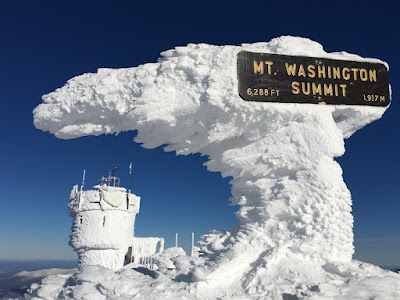
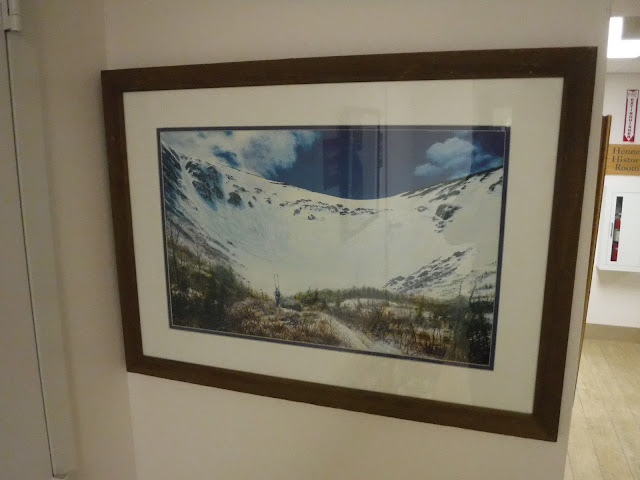
Friday, April 15, 2022

Happy World Art Day!


Forget that today is tax day. Instead celebrate World Art Day!
World Art Day was established ten years ago after a proposal was put forward at the 17th General Assembly of the International Association of Art (IAA) to declare April 15 as World Art Day.


According to the IAA, World Art Day celebrations help reinforce the links between artistic creations and society, encourage greater awareness of the diversity of artistic expressions and highlight the contribution of artists to sustainable development.

Art nurtures creativity, innovation and cultural diversity for all peoples across the globe and plays an important role in sharing knowledge and encouraging curiosity and dialogue. These are qualities that art has always had, and will always have if we continue to support environments where artists and artistic freedom are promoted and protected. In this way, furthering the development of art also furthers our means to achieve a free and peaceful world.

It is also an occasion to shine a light on arts education in schools, as culture can pave the way for inclusive and equitable education.

There is much to learn, share and celebrate on World Art Day, and UNESCO encourages everyone to join in through various activities such as debates, conferences, workshops, cultural events and presentations or exhibitions.

April 15 was chosen for World Art Day as it is also the birthday of Leonardo da Vinci, a symbol of world peace, freedom of expression, tolerance, brotherhood and multiculturalism. 

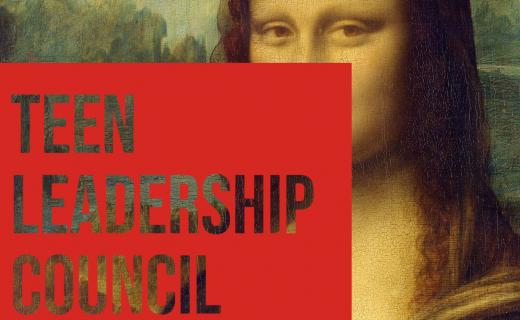
DaVinci's Mona Lisa was used to promote the Conway Public Library's display and silent auction of local art.  
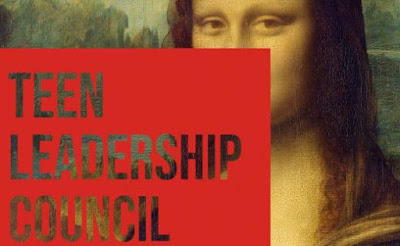

The curious, but judgmental, chicken above is one of the paintings available through the silent auction which is being held to raise funds for our Teen Leadership Council. The auction is being held at the library until April 30 at 1pm so put your bid in early and often. 
  
FMI and to see all the 27 works of art in the auction see the link here
 
The paintings are on display in the circulation area stacks. 
 

 Can you find the chicken painting in the photo above?
You can also see some important examples of earlier local art of the White Mountains on display at the Conway Public Library. An internet search for the keywords "mwvhistory art" here yields images of some of the artworks we have explored in previous blogs here. 

Last night, Inez McDermott presented an excellent introduction to White Mountain art and artists as part of a lecture series hosted by the New Hampshire Historical Society in celebration of a temporary exhibit there. The lectures are being recorded for future research. 

FMI see this link here

Inez started her presentation with this painting by Winslow Homer entitled Artists Sketching in the White Mountains


I argue that the view is from North Conway's Sunset Hill, now the site of the Red Jacket Resort. FMI see our previous blog here

Inez also explained the important role that Benjamin Champney had in developing White Mountain Art. The Conway Public Library's Henney History Room offers a number of free outreach programs on White Mountain Art, some of which include examining some of the seventy plus items related to Champney in the collection of the Conway Historical Society including an artist's folding stool like the one seen in the painting above, Champney's brushes, sketchbooks, chromolithographs, vasculum, trade sign, painted firescreen, rocking chair and even his baby bonnet.


z

Saturday, April 9, 2022

Happy Antique Day!


Today is National Cherish an Antique Day! In the photo above, my son is posing with my grandfather's coal miner's helmet. It is now a treasured family heirloom. My grandfather was about ten years old when he started working in the mines. 

The thrill of antiques cuts across the generations. For a while now, the Conway Public Library's Henney History Room has been doing an outreach program at the Mount Washington Valley Adult Day Center using historical artifacts from the collection of the Conway Historical Society. 


Our program is just one of many that the Center provides with the help of local resources including health, fitness, dance and craft programs. 


We present a new program a couple times a month. In our "hands-on" program we use these artifacts to stimulate exploration and discussion about the larger cultural stories that these items tell.  


We have covered themes such as women's work, farming tools, and keeping warm for the winter. 

We offer similar programs for free to local schools and community groups. One school asked for a program on the history of local crafts and trades. 


One of the collections we included in that program were these wooden shoe heel blocks showing the stages involved in making historic shoes. The heel factory building these were made in still exists on Conway's Main Street just a short walk from the library. 

Recently we did a program of "mystery items." As soon as I pulled the item below out of a box one of the participants immediately recognized it and told us all how she remembered standing over one of these with her mother adjusting the hems on dress she made. 


This was a new discovery for me and after closer examination we did find the word "hem" stamped on it. 


We also found who made it and the patent number. FMI see the link here.


We soon looked it up on Google patents and learned even more. 
Another participant told us about this glass item and said it was for cutting the dough for tea biscuits that were boiled in water. 


Does anyone know more about this item? I have not been able to find another documentation on it yet. 

In previous blogs we have looked at antiques used as lawn decoration. 


FMI see this link here


Another interesting antique that serves as the Conway Public Library's official mascot was featured in our previous blog here

If you have cherished antiques of your own and want to learn more about saving or preserving them, searching or researching them and sharing them through family stories, scrap books or your own family history website let us know and we can suggest the best ways and more importantly the methods not to use. Did you know there are "good plastics" and "bad plastics" to keep your priceless heirlooms in? Especially bad are those so-called "magnetic" photo albums that were popular a number of years ago. 

So be careful! Be educated! And enjoy!


Tuesday, April 5, 2022

Happy National Read a Road Map Day!


Today is National Read a Road Map Day. It encourages people to go on an adventure the old fashioned way, with a paper map! We took the advice and drove up through Crawford Notch this afternoon. 

A keyword search in the Conway Public Library's Henney History Room online catalog for the word "map" yields 475 results. Try it through this link here

The collection includes tourist maps from guidebooks, geological maps, soil type maps and even a  handwritten map by John Cannell on the back of photo on how to find the site of the Wizard Birch.

A search for the word "map" in our main library catalog here yields 21,118 items including maps, books on maps, and even novels with the word map in the title.

In this blog today, we will look at just a handful of maps intended to whet your appetite. Of course we would be happy to show you around our map collection and we do offer a free outreach program on historic maps and map making for local schools and community groups, 

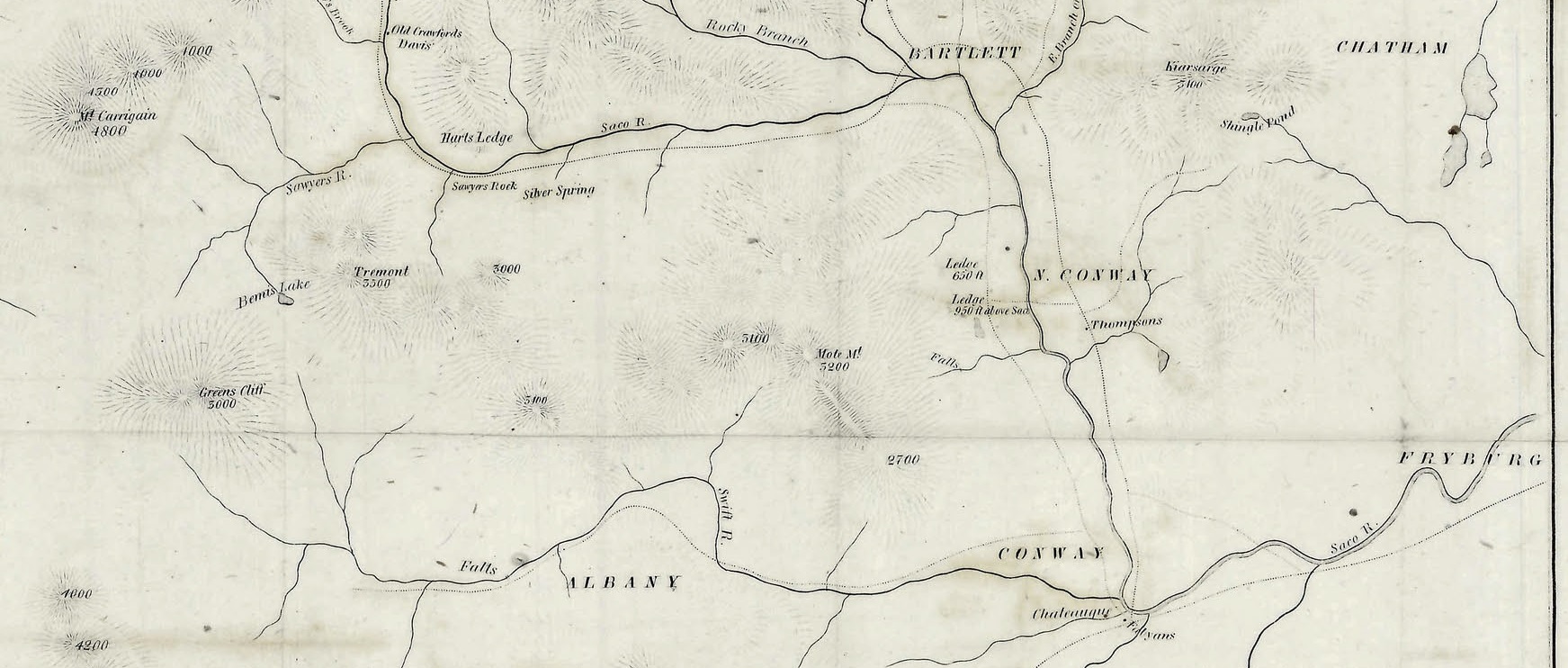
Let's start with the 1853 Bond map. We have two copies here of the book that it came from here. (click on images to enlarge them).  The library has a number of copies of  Benjamin Willey's book, Incidents in White Mountain History. For preservation reasons one of the maps was removed from the book and cataloged and stored separately listed in our catalog here


Here is a detail of the map... 


... and details showing how it served as a road map following the route we took today. 


According to a description by Adam Apt on the White Mountain History website here, the map was issued in boards covered with cloths of different colors. In some copies, Benjamin Champney illustrations were printed on the reverse of the map; in others, these are printed on a separate sheet. 

Now let's look at Boardman's White Mountain Guide, 1858. As you can see this map features the mountain topography more prominently. FMI see this link here


Details:


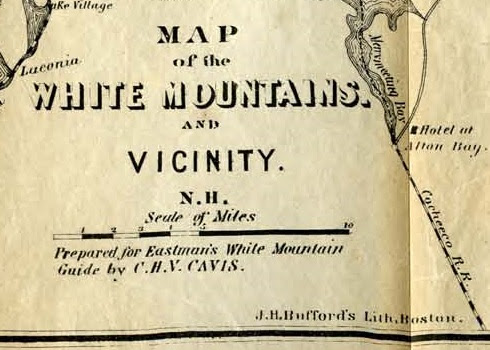
Now let's look at the Eastman/Cavis map. 


This copy is from the White Mountain History website here

... with details here. 


One of our copies at the Henney History Room shows the problem (inherent vice) of maps that have been "tipped" into books. 


Again for better preservation the map has been cataloged separately here

Now let's go way back in time. Did You Know that the Turin Papyrus is thought to be the oldest recorded road map in the world? Historians believe that it was created around 1160 BC.


FMI see this link here

It is in fact also a treasure map. Inscriptions describe the "Mountain of the Gold”, the “Mountain of the Silver.” It is also the earliest known geological map because it showed the local distribution of different rock types, the diverse wadi gravels, and contained information on quarrying and mining.

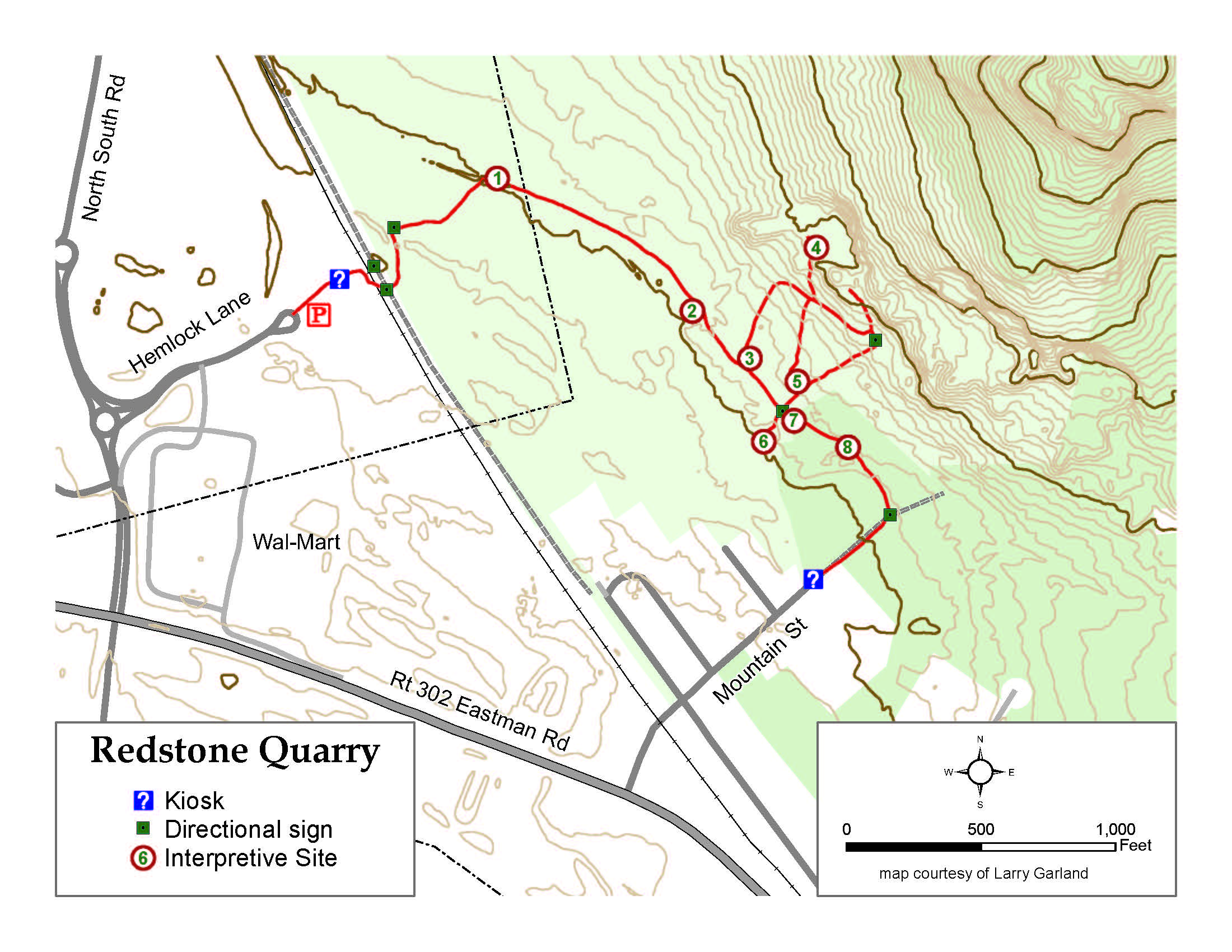
Now for our final and most recent map. The map below was only created last month by cartographer Larry Garland and shows the planned trail into the Redstone Quarry as well as key landscape features and topography. 


Larry collected the GPS data points with his high quality "backpack" style equipment on March 27, 2022. 


For more information on this project or any local history topic contact us at the Conway Public Library.

Wednesday, March 30, 2022

Headin' for the Rhubarb...


... so they say.


While the deadline for removing bob houses from New Hampshire lakes and ponds is not until April 1, I would not recommend waiting until then. 

If you do, you are just "headin' for the rhubarb." 

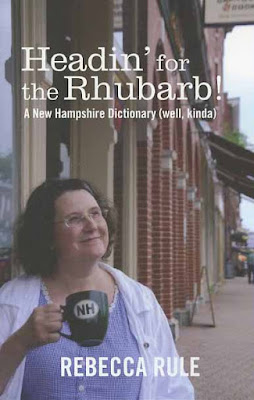
Colloquially that phrase means you are about to "get into trouble," as explained in Rebecca Rule's New Hampshire dictionary of the same title. 


You can find her book in several libraries in the Mount Washington Valley. See this link here

However, phrases can have multiple meanings, or layers of meaning. In another, seasonal sense, the title of this blog can refer to the traditional role of heading towards the season of rhubarb, one of the early crops we harvest fresh up here. 


Historically in New England the rhubarb harvest is an almost sacred celebration as it represents the end of winter, the end of fear from famine and the promise of a new beginning. 

However in New England, the transition from winter to spring is not often quick nor consistent. 

While the astronomical beginning of Spring started more than a week ago, it will still be a bit before we can actually harvest the rhubarb. 

It will be almost two months before the cows go out, so historically farmers would check the hay left in the barn this time of the year. 

For most of us, this time of scarcity is more of an inconvenience than an actual struggle between life and death as it was for many in the past. 

Meteorologically winter has returned with a vengeance. We hear the weather on the nightly news punctuated with terms like wintry mix (sleet, snow and rain), arctic blasts, record cold and a frigid feel due to the wind chill. 

Charles Dickens wrote about this climatic variability when he said “It was one of those March days when the sun shines hot and the wind blows cold: when it is summer in the light, and winter in the shade.”

Other writers have sung the promises of spring and the harvest to come. Our own Eaton Poet, Thomas Randall wrote in his poem entitled "Birth of Spring and Death of Winter" that ...

Phebus comes with brilliant rays, 
Cuts short the nights t' increase the days; 
He now forsakes the southern pole, 
Around the northern start to roll

Phebus in Greek mythology is also known as Apollo or the sun. 
To learn more about the science behind the seasons see our previous blog here
In the last stanza he writes...

Here now I'll drop these scatter'd lines, 
And hope and wish for better times, 
When nature all shall join and bring 
Some livelier airs that all may sing

FMI see this link here

This optimism of spring is tempered by another, bit more well-known poet, Robert Frost. In "A Prayer in Spring" he opines...

Oh, give us pleasure in the flowers to-day;
And give us not to think so far away


While he refers to the pleasure of spring and the promise of the harvest, he continues... 

As the uncertain harvest; keep us here
All simply in the springing of the year
.

His underlying theme is to both enjoy the moment, hope for the best, but prepare for the worst. 

I had a lot to learn about New Hampshire when we moved here more than a quarter century ago. For one thing, I learned that I will always be a flatlander.  

In her dictionary, Rebecca Rule says in New Hampshire a flatlander is anyone born south of the state line. For those born in the White Mountains a flatlander is anyone born south of the notches. And for those hardy few who man the observatory on top of Mount Washington, a flatlander is everyone but them. 

I literally had to learn to read the signs of Spring. Instead of flowers in March, we get bright orange signs that read "Frost Heaves." 


You can read our previous blog on wicked nasty frost heaves and politics here

I discovered that perhaps the best solution is to laugh it off. See our previous blog here about the droll Yankee approach which coincidentally connects mud, hats, maps, bird feeders and local history.  

In her dictionary, Rebecca Rule tells a short story about frost heaves and politics, but I will leave it up to you to check out her book to read it. 

There is another humorist, Ken Sheldon who performs under the name Fred Marple from the fictional town of Frost Heaves. FMI see this link here and his facebook page here

During mud season the towns also post signs reading "Load Limits." I had to look that up too. 

Another "must read" Rebecca Rule book is Moved and Seconded. Town Meeting in New Hampshire, the Present, the Past, and the Future


You can find info about the book here. You can visit the Conway Public Library's Henney History Room to view our collection of town reports, ledgers and papers for the history of Conway. The Conway Public Library also offers a free public program on all things spring and seasonal for local schools and community groups. 

Not that long ago Conway went to an SB2 form of Town Meeting with the town elections and final voting on the town warrant articles coming up April 12. 
 
Now that's what I call headin' for the rhubarb!

Tuesday, March 1, 2022

Shrove Tuesday


This is the second in a series of blogs about winter. It follows an exploration of Candlemas here.  A future blog will explore more about how our ancestors survived the winter. 

This blog focuses on food. In a time before refrigeration and other modern technology winter was a time of hardship or even death. 

Living history, like the hearthside cooking event seen in the photo above, can help us understand more deeply the challenges our forebears experienced. In the past, most people were farmers and I consider understanding their basic experiences a significant part of researching family history and genealogy (something we do a lot of at the Conway Public Library's Henney History Room). Those photos and paintings and heirlooms of your ancestors become more meaningful when you understand the way they lived and we  offer many free outreach programs to local schools and community groups to accomplish that goal.

Today is Shrove Tuesday. as well as Mardi Gras, Fat Tuesday, pancake day and paczki day. All these have to do with the idea of celebrating the survival of winter.  Through living history programs we have taught basic historical skills such as ice harvesting, maple sugaring, food preservation, woodworking, etc. ... all of the skills common folk would have used to survive a cold, dark, New England winter.

Shrove Tuesday was also known as the deadline for weddings before Lent. Living history is also good way to understand how women were trained since childhood for the goal of being a "Good Wife." FMI see the book which you can get through the library here


Farm and time

The photo below helps set the tone for a farmer's winter. 


This plow, currently on display at Banners restaurant, is anxiously awaiting the Spring which starts on March 20. You can see the plow share in the snow behind the sulky seat. You can also see the hand and foot pedals/gears which control the action of the plow itself. FMI see our previous blog here

Another way of viewing the farmer's year is this chart from Thomas Hubka's book Big House, Little House, Back House, Barn

As fresh foods were not easily available during New England winters, many meals relied on preserved foods. For our previous blogs on preserving foods in the autumn for winter see here and here and here

Some of our outreach programs use a series of artifacts to explore technological change over time. For pancakes this might include the differences between a basic cast iron frying pan...

... to a specialized pan...


...to a automatic commercial unit. 


Now back to the little girl in the first photo above. As I said before, we did teach her the skills to survive a cold, dark, snowy New England winter with only nineteenth-century technology.  

However, she decided that the easiest way to survive a New England winter was to move to Florida where the hibiscus bloom in February... 


... and weddings are held under the palms in a subtropical garden. For more on our daughter's bridal path see our previous blog here

While spring starts all over the northern hemisphere on March 20, it will be a while before we can pick fresh strawberries up by Cathedral Ledge. 

In Florida the strawberry harvest festival starts in a couple days. 
FMI see here

March is also the beginning of the "march of the strawberries."

In his book The White Hills; Their Legends, Landscape and Poetry, Thomas Starr King starts his chapter on the Saco Valley with a strawberry story.

“We once heard of a traveller who went down to New Orleans, every spring and came North just fast enough to keep pace with the strawberries. He managed to rise on the degrees of latitude at even speed with the bounteous vines and ascending village by village and city after city plucked and ate and thus extended the spring time for his palate all the way from the Gulf of Mexico to Montreal.” 

Now that is a trip I would like to try myself! You can read the passage in his 1864 online edition, p. 137 here.

Wednesday, February 2, 2022

Candlemas: Superstition, Science and Art

As I write this...


... a storm is brewing.
 
However, it felt like a warm spring day when I walked up the stairs to work this morning. The temperature will swing from its current balmy 37 degrees down to minus 10 Saturday night. The skies will range from today's clear haint porch blue (a reference to a superstition - more on that later) to cloudy and overcast, to rain, to snow, and ice - all in the next four days. We will soon have our second nor'easter in as many weeks. 

This morning a furry rodent saw his shadow and forecast six more weeks of winter. 

Naturally, I thought of Samuel Lancaster Gerry's 1855 painting The Snow Line, Mount Washington, New Hampshire in the collection of the North Carolina Museum of Art. (FMI and to use their nice online zoom feature see this link here). 

You can divide the painting in half to watch the progress of the coming storm. 

On the right, you can see gray and pink clouds and patches of ultramarine and baby blue sky. Below that, you can see a man holding a staff with his ever watchful dog standing by. Presumably they are herding the cows that follow a line towards the water. Silhouetted on the ridge to the right is the last straggling cow and a man on horseback who brings up the rear of the herd.  

The left side of the painting shows the dark storm clouds coming in, the frosted branches of the trees, and the billowing, wind-whipped, puffs of snow. 

In the middle ground are the stark profiles of rocky ledges and beyond that in the distance the summit of Mount Washington, the tallest mountain peak in New England. 
 
In the photo below you can see the fascinating phenomenon of rime ice on the summit.  These feathery fronds of ice actually form into the wind which approaches from the left in the photo. 


With facilities like the observatory we have come a long way in weather monitoring and forecasting. FMI see this link here.
 
Winter on Washington has been a subject of interest for over 150 years, since the first over winter expedition of 1870-1871.  

In fact these frost feathers (rime ice) were featured in an illustration from the book that documented the expedition (facing p. 286). You can read it online here or see it for yourself in the Conway Public Library's Henney History Room here


The cover of the book celebrates the cog railway which still operates today (FMI see this link here). 


FMI see our previous blog here

In the following illustrations you can see some of the period meteorological instruments.  


One member of the party was a photographer and he created a series of stereoviews from the expedition. FMI see our previous blog here

While rare, there are a number of other winter related White Mountain paintings. You can see more of them at this link here

While the focus of these paintings is on the overall beauty of the landscape, they often capture little details showing activities of the period. 

Can you see the horse logging operation? 


and oxen below...


...farmers driving their livestock...


Look at the details included here to see the frozen laundry hanging on the line. 

However, it was not all work. There was also fun, such as ice skating...


... and magic. Maxfield Parrish was able to capture the essence of a winter twilight.  


Winslow Homer's dusky sleighing scene below is almost an abstract painting.  


We have several paintings on display in the Conway Public Library's History Hall.


Tuckerman's Ravine is a popular ski spot that can be skied well into the Spring. As there are no lifts here, one must hike up to nail that experience. 


Here are some of the routes skied in the ravine. 


Winslow Homer was adept at capturing evocative slices of life in his illustrations.  The period from about 1300 to 1850 was known at "the little ice age" and you can see that in this picture. 


In a future blog we will look at ways in which they kept themselves warm during the winter, what they ate, and how (besides a superstitious folktale about a groundhog) they forecast and prepared for the weather. 

To gain an intimate understanding of our New England winters, the Chocorua Lake Conservancy is hosting a Winter Camping Expo, on Saturday, February 12. FMI see this link here and here
 
Dedicated winter campers Geoff Burke, Dave Evans, and Sheldon Perry will share what they’ve learned about winter camping, trekking, and seasonal trapping and hunting, and offer a show and tell of traditional heated tents and trekking toboggans. Hot drinks and warm soups will be available around the campfire. Come when you like and enjoy the company of friends and neighbors out-of-doors, ask questions, and share your own winter camping stories.

For more information on this and other local history subjects contact us at the Conway Public Library's Henney History Room.