Monday, October 4, 2021

Cole in Conway 193 years ago today


It was a dark and stormy night 193 years ago today when Thomas Cole and his traveling artist companion, Henry Cheever Pratt spent the night in Conway, New Hampshire.

This loose pen and ink sketch over graphite pencil on a torn and stained piece of paper is evidence of this visit. 

It is now in the collection of the Detroit Institute of Arts. You can read more about this sketch here

The tale is narrated from notes written by both Cole and Pratt.  

Cole wrote "After a long lonesome walk through a dark gloomy forest - after dark we arrived at Conway -"

Pratt wrote that they stayed at "Abbot's" which Catherine Campbell suggested may have been Thomas Abbott's Pequawket House in Conway where Kennett Middle School is located now. 

While their travel was difficult with rain, winds, washed out bridges and the like, Cole and Pratt found many scenes they deemed “worthy of the pencil." Cole felt that "These views were well composed for pictures -”


In the bottom right hand corner of the sketch are a series of mysterious scribbled shapes and below the scribbles is the label "Root fence." 

A similar, if not the same, view point and perhaps the same root fence, was painted by the artist Charles Herbert Moore in 1872, forty-four years later now at the Princeton Art Museum. 


Here is the overall view. 


For more information on this art work see this link here

The Farmer's Museum in Cooperstown New York has recreated a stump fence as part of their living history program. 


Conway was the inspiration for a sketch that later were turned into a print and was then adapted for a transfer printed ceramic plate. Look for the log cabin in each image (click on images to enlarge them). 


If you are interested in learning more about Thomas Cole in Conway contact us at the Conway Public Library’s Henney History Room. We offer free outreach programs to local schools and community groups on this subject and many other historical subjects.

Sunday, October 3, 2021

Cole and Chocorua 193 years ago today

A friend recently posted this on facebook. 


I added this image to the post (click on images to enlarge them) ...


... and commented that ... 


If you follow the link here you will be directed to the collections search website for the Detroit Institute of Arts. This search for "Chocorua" results in 16 items of over 3,000 items they have on Thomas Cole including many sketches he made in New Hampshire's White Mountains. 

15 of the results are sketches, most of which are pretty recognizable to those who have climbed Chocorua. 

This one here is part of the text he wrote about the trip. 

Chocorua has continued to fascinate artists (and historians) to this day.  

Like Cole, John Marin did many versions of Chocorua.


This one now at Harvard was featured in a recent online program that can be seen on vimeo and youtube here

Frank Stella's Chocorua at Dartmouth is one of many versions that can be found in other museums. For more versions see this link here


If you are interested in learning more about Chocorua contact us at the Conway Public Library's Henney History Room. We offer free outreach program to local schools and community groups on this subject and many others.  

Wednesday, July 28, 2021

Banking on History


Who knew that a quick stop at the bank would lead to a lesson on local history? 

This photograph is prominently displayed at the North Conway TD Bank (2651 South Main Street). The top of the arch reads, "North Conway Welcomes You."  The arch and it's supporting piers are festooned with wreaths, flags and garland. Here is the overall "history on parade" photo. 


While I am not sure exactly where this photo was taken from, I recognize it as one of the arches built for the annual coaching parades held in the area around the end of the nineteenth-century. For more information on these coaching parades, see our previous blog here. We have more material on our online history catalog see here and many references to coaching parades in our online collection of the Reporter News here

This display photo was enlarged and colorized from an original black and white photograph in the collection of the New Hampshire Historical Society.  


For more information on that original photograph see their website here

The website records the caption written on the photo and reads in part "Coaching Parade/ Fall of 1893, ... J.W. Fisher with his first bicycle, ...I went to No. Conway with my wife on train" 

On the bottom right of the photo you can see J.W. Fisher and his bicycle as well as the benches for guests to watch the parade. 


Towards the bottom middle of the photo, you can see a wagon bought in from Rochester to compete in the event. 


Note the long coaching horn the young boy is holding similar to the one at the Conway Historical Society. 

A detail of the lower left corner of the photo shows a team of four horses covered in fly netting.  


It is ironic that a Canadian company takes pride in our local history while most of our more local companies, including the outdoor outfitter companies, do not make the effort to display (and inform) their visitors about the local scene as part of their marketing and PR.

Is is nice to have local history on display in the area. The TD Bank branch near Burger King (locals know that area as "bowling alley hill") has a great photo of Cathedral Ledge on display. In fact even the Burger King (another Canadian owned company) has local New Hampshire images. Applebee's Neighborhood Grill (another global company) is a great place to get immersed in local history.

So get out, explore and enjoy! But remember don't go out until you first come in to the Conway Public Library's Henney History Room to find out the history of what is out there!

Thursday, July 1, 2021

Independence Day

 
Time to get ready, not just for this weekend, but for the big event in 2026 which will mark the 250th anniversary of our Independence Day in 1776. 

Today, the American Association for State and Local History released The Field Guide for the Semiquincentennial, Making History at 250. You can find the field guide at this link here

It inspired me to get started, gathering and reviewing resources, in the Conway Public Library's Henney History Room and looking around on the internet about New Hampshire's role in the American Revolution. 

I hope that we can get schools and community groups involved in celebrating this important event. We would certainly be happy to help with any projects. 
 
Did you know that one of the first overt acts of the Revolution occurred in New Hampshire before the "shot heard around the world" in Massachusetts? You can read about it here

One of the first printed copies of the Declaration of Independence is on display at the American Independence Museum in Exeter New Hampshire. 


Do you know who signed the Declaration of Independence for New Hampshire? What military and naval leaders hailed from the State? Where our Revolutionary War soldiers are buried nearby? The names of the signers of the Conway Association Test? Do you know what the Association Test was? 


You can find the answers to these and many other questions at the Conway Public Library's Henney History Room. 


Live Free or Die!

Monday, June 28, 2021

Beast Feast

Now here is something you don't see everyday

This past weekend we were treated to an awfully good cook-out in Bridgton, Maine put on by Dana Masters, the owner/operator of Beast Feast Maine. See their website here. For a taste of your own, you can participate in one of their upcoming barbecues listed on their website under the events tab. 

The main focus of this event featured an alligator gobbling up a bunch of New England lobsters. It was a real piece of culinary art and a visual oxymoron. This captivating contrast (or is it a fusion?) led me to reflect upon the similarities and differences in different parts of the country that define and express our cultural identity. 


As noted before in a previous blog here, traditions now considered "American" go back much further than the Pilgrims. America's first Thanksgiving and Christmas may well have featured grilled gator as seen in this print, published in 1591 from a lost drawing of 1564, depicting the Timucua in Florida. For more information see these links here and here

The weekend's heat and humidity brought back memories of growing up in Florida, and made me think about "changes in latitudes, changes in attitudes" and especially how the use of natural resources, and specifically food, helps define regional culture. 

Even the weather was like Florida's. The day was marked by a high mackerel ceiling and massive, towering stacks of cumulonimbus. To get there we drove through many miles of pines past dark tannin waters. 

However, the sand we passed was brown not white, the beaches are edged with pebbles not shells, the gator above is munching on American lobster (Homarus americanus) not the Spiney Florida lobster (Panulirus argus) which we caught by hand - try that with a Red lobster!

One thing notably missing were the palms of my youth. As I told Dana, when we had grilled gator, rattlesnake, armadillo or possum growing up, we usually had swamp cabbage as a side. 


Swamp cabbage is harvested from the Florida State Tree, the Sabal Palm. The edible part of the tree with the boot jacks still on can be found for sale in the more rural parts of the State. 


You peel off the boot jacks to reveal this...


... and with a little bacon, onion, salt, and pepper added, finally to this.  


Everyone has their own recipe and culinary secrets (mine includes guava paste, Tabasco and peanut butter). 

The Sabal Palm was also made into hats, brushes and combs. There is even an example of one owned by Winslow Homer on display in his studio now open for tours through the Portland Museum of Art here


As I have migrated north over the years, I have continued to study local history, art and craft. 

With a cracker whip maker at the Florida Folk Festival, 1983

We have now returned to our family's Yankee roots/routes (our family line goes back to a master mariner in Salem, Massachusetts and includes a branch that brews Cottrell Old Yankee Ale here). My great-grandfather fought for the Union during the Civil War. See my blog on that here

Remember, we offer free help with researching your family history and programs on preserving your family heirlooms. Contact us at the Conway Public Library.

Monday, June 21, 2021

Wayfinding

Thanks to these pathfinders the way has been found! 

From left Adam Jared Apt, David Govatski and Rebecca Enman  

Recently I had the incredible opportunity to visit the new Wayfinding exhibit at Plymouth State University's Museum of the White Mountains with some of the curatorial team that created it. They coordinated the contributions of dozens of lenders, sponsors and supporters, all of whom are credited at the beginning of the exhibit. You can read more about the exhibit here

We were accompanied by another historian and an interesting creative couple (one a furniture master, the other a book artisan) all with great interest and insights into maps and white mountain art and history.  

For an exhibit ostensibly about maps, they have created an astonishing story, using a wide variety of objects. 


Upon entering the space, you are greeted with an unexpected assemblage of disparate elements including a dog sled, ceramic plates, surveying tools, books, field notes, letters, stereo views and a bicycle wheel.  


(not that this has anything to do with Marcel Duchamp)


They have created a display environment of simultaneous intimacy and vastness. This was especially challenging due to the fact that much of  the interior architecture reveals that the building was once a church. That however is appropriate given the obvious reverence to the both the subject and its treatment in this space. 

The combination of two and three dimensional items on display is visually stunning and sculptural and the labels intellectually stimulating - even downright Shakespearean! 


Bard-like romantic and philosophical aphorisms comparing maps to campfires and epic poems and so on, are spread throughout the exhibit, with none of the confusing non sequitur saccharine nonsense about rose names and nightingale songs. This is real, important stuff!


The exhibit also features a video projection of the Hitchcock Atlas of 1878.  


Display cases allow close examination of rare and fragile items. Let's examine the two display cases we can see in the photo above and then navigate into the small room beyond them to explore how they expand on one subtopic - topography. 

The mysterious floating map above was created by Robert Scott by layering thin balsa wood sheets using cutouts from the Franconia quadrangle map.  


Below the Scott map is the 1872 Snow and Bradlee map made of papier-mache along with it's original packaging. This was one of two published relief maps of the region from the nineteenth century. 


The other, the 1879 Schedler relief map, can be found in the case along the wall (it is the larger map on the right). 


On the left side of this case, are two 20th century relief maps made by Conway's own Rodney Woodard along with a metal mold for making another of his plastic maps.  We have explored relief maps in previous blogs here and here and here

Now let's move to the doorway beyond and enter the "Mountain Studio."  


Here you will find a bright, bold, colorful, welcoming laboratory with hands-on activities to explore and create relief maps. It is fun for all ages! 


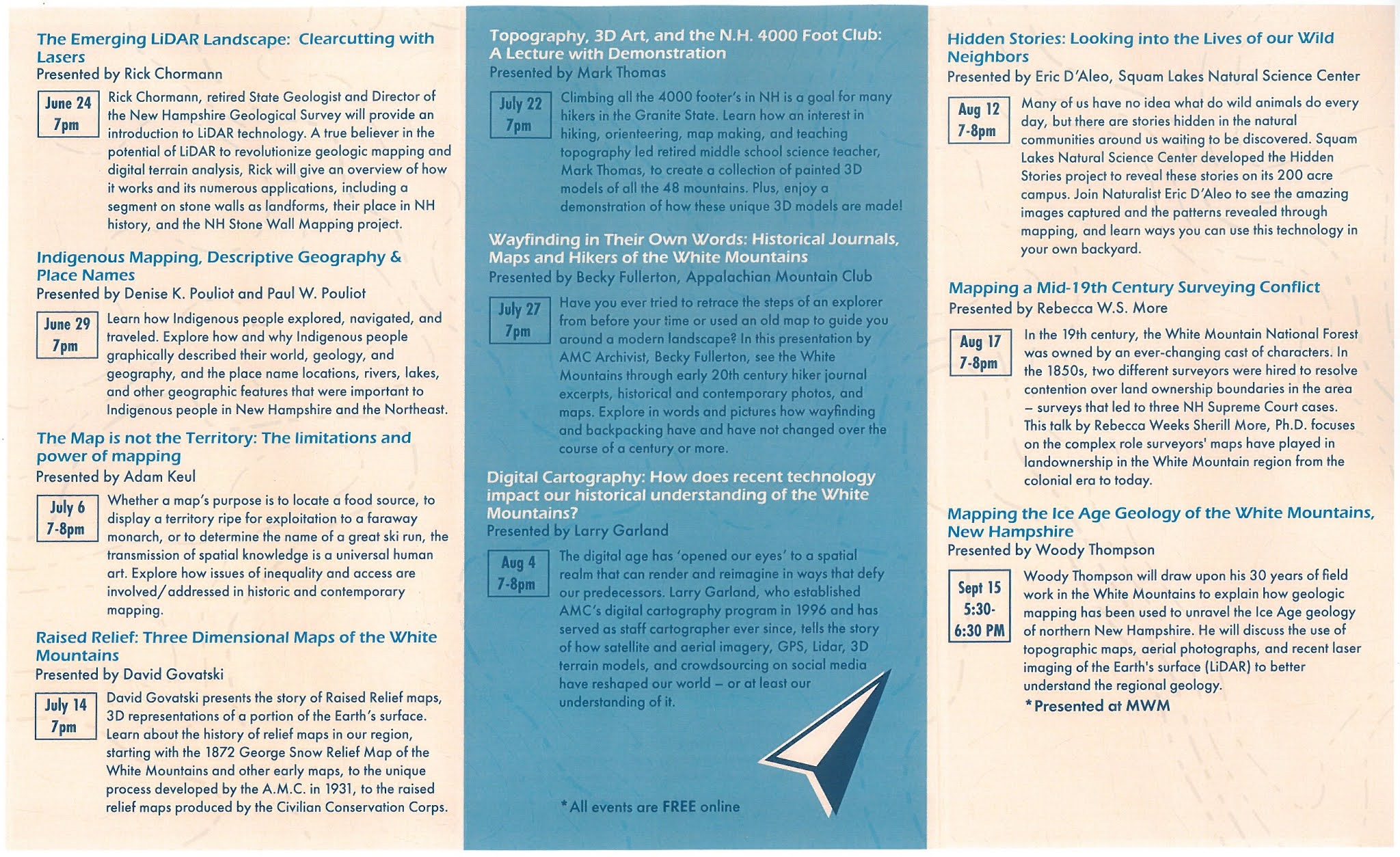
You should not leave the exhibit without picking up a few souvenirs and signing up for the summer speaker series. 

You can bring home a nice, always handy, book mark. 


Front of bookmark above
Back of bookmark below


Summer Speaker Series brochure


And a fold-out catalog of sorts chock full of images and information. 


While extensive in its scope, there is one type of map I would like to have seen included, namely the "vertical" maps created for rock climbers. 


See our previous blog here and related video of Cathedral Ledge here for an example. This map is also featured in our cell phone history mapping program theclio in which you turn on your cell phone's location (or search for a location, title, or ) and it guides you to local history sites. The entry for Cathedral Ledge is here


At the end of our adventure we were treated to an exceptional opportunity to see a new acquisition for one of the collector/curators, a hand-colored map showing the Portland to Ogdensburg railroad line. The railroad had many interesting connections to White Mountain art and history. For example see our previous blog here. You can read more about that railroad line here and here

In conclusion, remember ... 


Thanks for reading and please let me know what you think! For more maps visit us at the Conway Public Library's Henney History Room. We have over 400 maps in our collection!