Wednesday, March 30, 2022

Headin' for the Rhubarb...


... so they say.


While the deadline for removing bob houses from New Hampshire lakes and ponds is not until April 1, I would not recommend waiting until then. 

If you do, you are just "headin' for the rhubarb." 

Colloquially that phrase means you are about to "get into trouble," as explained in Rebecca Rule's New Hampshire dictionary of the same title. 
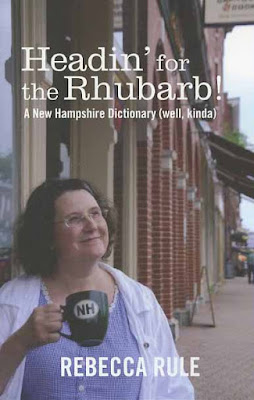

You can find her book in several libraries in the Mount Washington Valley. See this link here

However, phrases can have multiple meanings, or layers of meaning. In another, seasonal sense, the title of this blog can refer to the traditional role of heading towards the season of rhubarb, one of the early crops we harvest fresh up here. 


Historically in New England the rhubarb harvest is an almost sacred celebration as it represents the end of winter, the end of fear from famine and the promise of a new beginning. 

However in New England, the transition from winter to spring is not often quick nor consistent. 

While the astronomical beginning of Spring started more than a week ago, it will still be a bit before we can actually harvest the rhubarb. 

It will be almost two months before the cows go out, so historically farmers would check the hay left in the barn this time of the year. 

For most of us, this time of scarcity is more of an inconvenience than an actual struggle between life and death as it was for many in the past. 

Meteorologically winter has returned with a vengeance. We hear the weather on the nightly news punctuated with terms like wintry mix (sleet, snow and rain), arctic blasts, record cold and a frigid feel due to the wind chill. 

Charles Dickens wrote about this climatic variability when he said “It was one of those March days when the sun shines hot and the wind blows cold: when it is summer in the light, and winter in the shade.”

Other writers have sung the promises of spring and the harvest to come. Our own Eaton Poet, Thomas Randall wrote in his poem entitled "Birth of Spring and Death of Winter" that ...

Phebus comes with brilliant rays, 
Cuts short the nights t' increase the days; 
He now forsakes the southern pole, 
Around the northern start to roll

Phebus in Greek mythology is also known as Apollo or the sun. 
To learn more about the science behind the seasons see our previous blog here
In the last stanza he writes...

Here now I'll drop these scatter'd lines, 
And hope and wish for better times, 
When nature all shall join and bring 
Some livelier airs that all may sing

FMI see this link here

This optimism of spring is tempered by another, bit more well-known poet, Robert Frost. In "A Prayer in Spring" he opines...

Oh, give us pleasure in the flowers to-day;
And give us not to think so far away


While he refers to the pleasure of spring and the promise of the harvest, he continues... 

As the uncertain harvest; keep us here
All simply in the springing of the year
.

His underlying theme is to both enjoy the moment, hope for the best, but prepare for the worst. 

I had a lot to learn about New Hampshire when we moved here more than a quarter century ago. For one thing, I learned that I will always be a flatlander.  

In her dictionary, Rebecca Rule says in New Hampshire a flatlander is anyone born south of the state line. For those born in the White Mountains a flatlander is anyone born south of the notches. And for those hardy few who man the observatory on top of Mount Washington, a flatlander is everyone but them. 

I literally had to learn to read the signs of Spring. Instead of flowers in March, we get bright orange signs that read "Frost Heaves." 


You can read our previous blog on wicked nasty frost heaves and politics here

I discovered that perhaps the best solution is to laugh it off. See our previous blog here about the droll Yankee approach which coincidentally connects mud, hats, maps, bird feeders and local history.  

In her dictionary, Rebecca Rule tells a short story about frost heaves and politics, but I will leave it up to you to check out her book to read it. 

There is another humorist, Ken Sheldon who performs under the name Fred Marple from the fictional town of Frost Heaves. FMI see this link here and his facebook page here

During mud season the towns also post signs reading "Load Limits." I had to look that up too. 

Another "must read" Rebecca Rule book is Moved and Seconded. Town Meeting in New Hampshire, the Present, the Past, and the Future


You can find info about the book here. You can visit the Conway Public Library's Henney History Room to view our collection of town reports, ledgers and papers for the history of Conway. The Conway Public Library also offers a free public program on all things spring and seasonal for local schools and community groups. 

Not that long ago Conway went to an SB2 form of Town Meeting with the town elections and final voting on the town warrant articles coming up April 12. 
 
Now that's what I call headin' for the rhubarb!

Tuesday, March 1, 2022

Shrove Tuesday


This is the second in a series of blogs about winter. It follows an exploration of Candlemas here.  A future blog will explore more about how our ancestors survived the winter. 

This blog focuses on food. In a time before refrigeration and other modern technology winter was a time of hardship or even death. 

Living history, like the hearthside cooking event seen in the photo above, can help us understand more deeply the challenges our forebears experienced. In the past, most people were farmers and I consider understanding their basic experiences a significant part of researching family history and genealogy (something we do a lot of at the Conway Public Library's Henney History Room). Those photos and paintings and heirlooms of your ancestors become more meaningful when you understand the way they lived and we  offer many free outreach programs to local schools and community groups to accomplish that goal.

Today is Shrove Tuesday. as well as Mardi Gras, Fat Tuesday, pancake day and paczki day. All these have to do with the idea of celebrating the survival of winter.  Through living history programs we have taught basic historical skills such as ice harvesting, maple sugaring, food preservation, woodworking, etc. ... all of the skills common folk would have used to survive a cold, dark, New England winter.

Shrove Tuesday was also known as the deadline for weddings before Lent. Living history is also good way to understand how women were trained since childhood for the goal of being a "Good Wife." FMI see the book which you can get through the library here


Farm and time

The photo below helps set the tone for a farmer's winter. 


This plow, currently on display at Banners restaurant, is anxiously awaiting the Spring which starts on March 20. You can see the plow share in the snow behind the sulky seat. You can also see the hand and foot pedals/gears which control the action of the plow itself. FMI see our previous blog here

Another way of viewing the farmer's year is this chart from Thomas Hubka's book Big House, Little House, Back House, Barn

As fresh foods were not easily available during New England winters, many meals relied on preserved foods. For our previous blogs on preserving foods in the autumn for winter see here and here and here

Some of our outreach programs use a series of artifacts to explore technological change over time. For pancakes this might include the differences between a basic cast iron frying pan...

... to a specialized pan...


...to a automatic commercial unit. 


Now back to the little girl in the first photo above. As I said before, we did teach her the skills to survive a cold, dark, snowy New England winter with only nineteenth-century technology.  

However, she decided that the easiest way to survive a New England winter was to move to Florida where the hibiscus bloom in February... 


... and weddings are held under the palms in a subtropical garden. For more on our daughter's bridal path see our previous blog here

While spring starts all over the northern hemisphere on March 20, it will be a while before we can pick fresh strawberries up by Cathedral Ledge. 

In Florida the strawberry harvest festival starts in a couple days. 
FMI see here

March is also the beginning of the "march of the strawberries."

In his book The White Hills; Their Legends, Landscape and Poetry, Thomas Starr King starts his chapter on the Saco Valley with a strawberry story.

“We once heard of a traveller who went down to New Orleans, every spring and came North just fast enough to keep pace with the strawberries. He managed to rise on the degrees of latitude at even speed with the bounteous vines and ascending village by village and city after city plucked and ate and thus extended the spring time for his palate all the way from the Gulf of Mexico to Montreal.” 

Now that is a trip I would like to try myself! You can read the passage in his 1864 online edition, p. 137 here.
Wednesday, February 2, 2022

Candlemas: Superstition, Science and Art

As I write this...


... a storm is brewing.
 
However, it felt like a warm spring day when I walked up the stairs to work this morning. The temperature will swing from its current balmy 37 degrees down to minus 10 Saturday night. The skies will range from today's clear haint porch blue (a reference to a superstition - more on that later) to cloudy and overcast, to rain, to snow, and ice - all in the next four days. We will soon have our second nor'easter in as many weeks. 

This morning a furry rodent saw his shadow and forecast six more weeks of winter. 

Naturally, I thought of Samuel Lancaster Gerry's 1855 painting The Snow Line, Mount Washington, New Hampshire in the collection of the North Carolina Museum of Art. (FMI and to use their nice online zoom feature see this link here). 

You can divide the painting in half to watch the progress of the coming storm. 

On the right, you can see gray and pink clouds and patches of ultramarine and baby blue sky. Below that, you can see a man holding a staff with his ever watchful dog standing by. Presumably they are herding the cows that follow a line towards the water. Silhouetted on the ridge to the right is the last straggling cow and a man on horseback who brings up the rear of the herd.  

The left side of the painting shows the dark storm clouds coming in, the frosted branches of the trees, and the billowing, wind-whipped, puffs of snow. 

In the middle ground are the stark profiles of rocky ledges and beyond that in the distance the summit of Mount Washington, the tallest mountain peak in New England. 
 
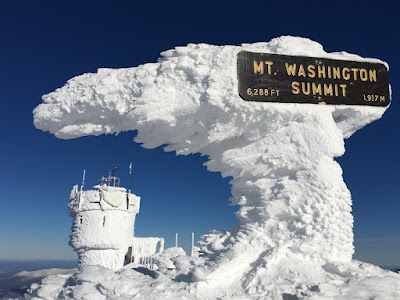
In the photo below you can see the fascinating phenomenon of rime ice on the summit.  These feathery fronds of ice actually form into the wind which approaches from the left in the photo. 


With facilities like the observatory we have come a long way in weather monitoring and forecasting. FMI see this link here.
 
Winter on Washington has been a subject of interest for over 150 years, since the first over winter expedition of 1870-1871.  

In fact these frost feathers (rime ice) were featured in an illustration from the book that documented the expedition (facing p. 286). You can read it online here or see it for yourself in the Conway Public Library's Henney History Room here


The cover of the book celebrates the cog railway which still operates today (FMI see this link here). 


FMI see our previous blog here

In the following illustrations you can see some of the period meteorological instruments.  


One member of the party was a photographer and he created a series of stereoviews from the expedition. FMI see our previous blog here

While rare, there are a number of other winter related White Mountain paintings. You can see more of them at this link here

While the focus of these paintings is on the overall beauty of the landscape, they often capture little details showing activities of the period. 

Can you see the horse logging operation? 


and oxen below...


...farmers driving their livestock...


Look at the details included here to see the frozen laundry hanging on the line. 

However, it was not all work. There was also fun, such as ice skating...


... and magic. Maxfield Parrish was able to capture the essence of a winter twilight.  


Winslow Homer's dusky sleighing scene below is almost an abstract painting.  


We have several paintings on display in the Conway Public Library's History Hall.


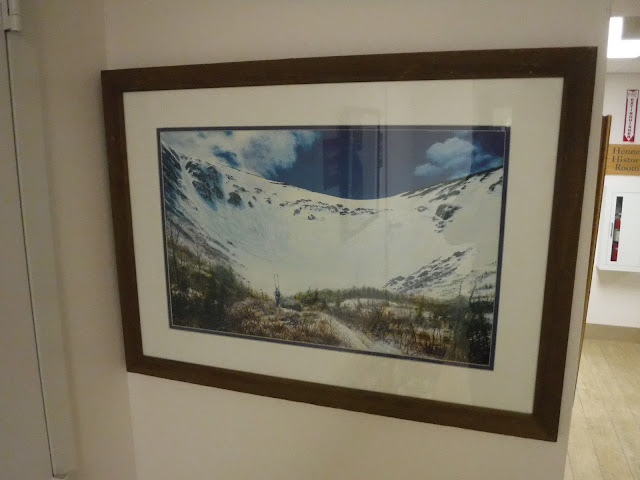
Tuckerman's Ravine is a popular ski spot that can be skied well into the Spring. As there are no lifts here, one must hike up to nail that experience. 


Here are some of the routes skied in the ravine. 


Winslow Homer was adept at capturing evocative slices of life in his illustrations.  The period from about 1300 to 1850 was known at "the little ice age" and you can see that in this picture. 


In a future blog we will look at ways in which they kept themselves warm during the winter, what they ate, and how (besides a superstitious folktale about a groundhog) they forecast and prepared for the weather. 

To gain an intimate understanding of our New England winters, the Chocorua Lake Conservancy is hosting a Winter Camping Expo, on Saturday, February 12. FMI see this link here and here
 
Dedicated winter campers Geoff Burke, Dave Evans, and Sheldon Perry will share what they’ve learned about winter camping, trekking, and seasonal trapping and hunting, and offer a show and tell of traditional heated tents and trekking toboggans. Hot drinks and warm soups will be available around the campfire. Come when you like and enjoy the company of friends and neighbors out-of-doors, ask questions, and share your own winter camping stories.

For more information on this and other local history subjects contact us at the Conway Public Library's Henney History Room.

Wednesday, January 5, 2022

Frosty Woods


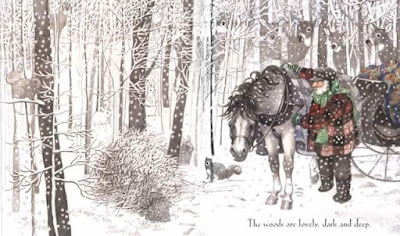
Recently a friend posted the illustration above by Susan Jeffers from a children's book on Robert Frost's poem along with the following on Facebook: “Three years ago this week, Frost’s poem “Stopping by the Woods on a Snowy Evening” became public domain. That poem is ours now. So, tonight, drop me your favorite line or stanza from Frost and what it means to your life.”

My reply focuses on the opening two lines: 

Whose woods these are I think I know.
His house is in the village though;

The opening lines of this poem naturally make me think about traditional New England vernacular land use patterns and farming practices. Isn't it the same for you? 

It raises the question, why would his house be separate from his woods? To address this enigma, we will turn to art, cartography, geology, ...  and of course lasers. 

Historically, to make the best use of the land a typical early New England farmer would own a variety of lots in different areas of a town. The best place for a sugar bush may not be a good place to pasture cows, or plant an orchard, or build a home, so depending on topography, soil types, elevation and so on different lots in different parts of town would serve different purposes. 

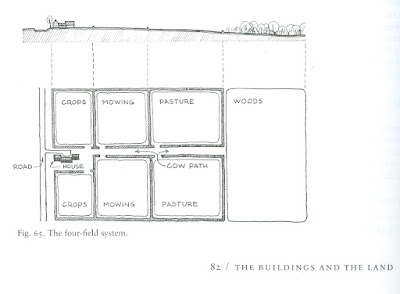
The land was organized by function - dooryard, barnyard, garden, crop fields, hay lots, pasture, and of course the woodlot. The paths connecting them were controlled by wood fences, gates, sheep dogs and stone walls. For our previous blog on reading stone walls from the ground and with lasers see this link here

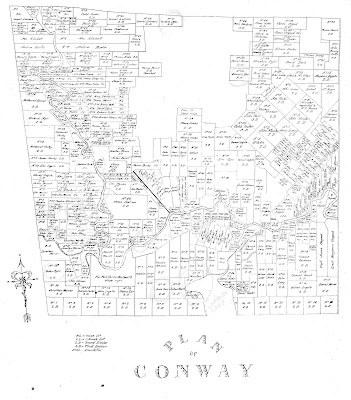
These lot patterns can be seen in an early map of Conway on display at the Conway Public Library. 


A closer look at another version of that map shows that the Town founders adapted the size and shape of the lots to the land (click on images to enlarge them). 


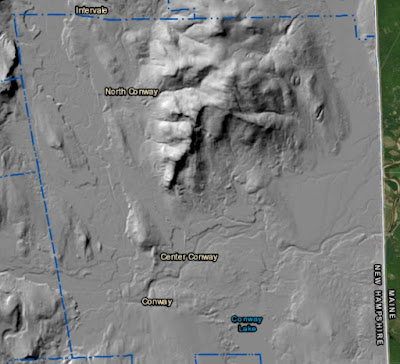
Here is a laser produced relief map known as LIDAR that shows the underlying topography of the town. 


For example, the Cranmore Mountain area can be seen as a large blank spot. This was not assigned to any specific person but was instead considered common land. The lots in the flat fertile areas and along the low hills of town are large. The lots along the rivers are smaller, long and narrow to allow the greatest number of farmers to have their livestock have access to water. 


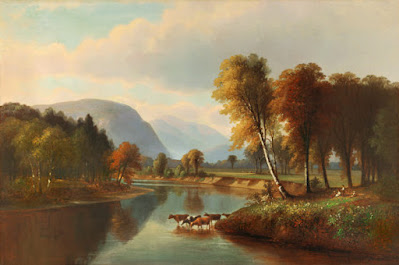
White Mountains artists captured scenes of livestock drinking from the Saco River in Conway, a practice that would not be allowed today.  You can see a number of them here

In his book, Big House, Little House, Back House, Barn, Thomas Hubka provides a great detailed explanation of these traditional field patterns. 


In his 1792 History of New Hampshire, Jeremy Belknap provided a "how to" manual for pioneers. He explains the kinds of soils that can be found under different types of trees and how that particular soil should be prepared there and what kinds of crops grow best in those soils. It also details the kinds of products that can be made from different trees and plants. 

Back to the children's book. I have always loved this edition of Robert Frost's poetry. You can check out this book with illustrations by Susan Jeffers at the Library as well as many other books she illustrated. 

For more information on this or any other Mount Washington Valley topic contact us at the Conway Public Library's Henney History Room.

Wednesday, November 24, 2021

Happy Thanksgiving 2021


We will be sharing our New Hampshire Thanksgiving virtually this year with friends and family in Florida, Virginia and the Netherlands. This is an historically interesting coincidence as all these seemingly disparate places also happen to play important roles in the Thanksgiving story. 


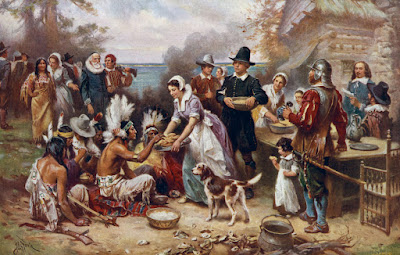
Many people imagine a scene like that above when they think of the first Thanksgiving said to be held in 1621 in Massachusetts. For more on this painting see the link here

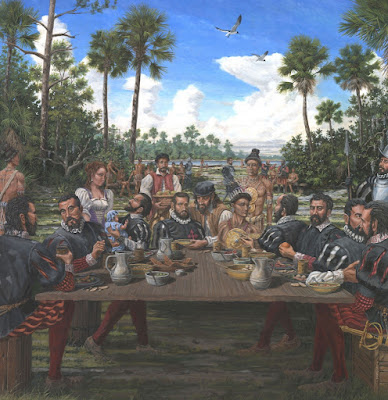
However, an earlier Thanksgiving in Florida in 1565 may have looked more like that below with Spanish Conquistadors, top-knotted Timucuans, longleaf pine and sabal palm trees (they may have even eaten part of the palm tree).  


For more on this argument see these links here and here. Instead of turkey, this thanksgiving would have more likely included gopher tortoise, mullet and gator.  


See our previous blog on a beast feast in Maine here


These images are from a book published in 1591.  


Another possible entree was Cocido-Madrileno, a stew made from salted pork and garbanzo beans laced with garlic seasoning.  


Even in Florida however, we were taught the Pilgrim version of the holiday in elementary school. 


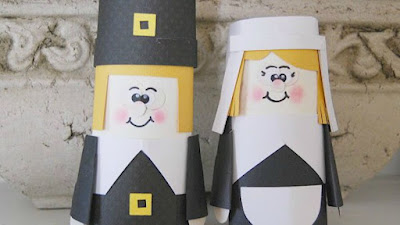
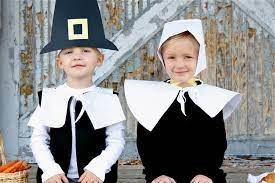
We had pilgrim pageants with construction paper costumes and played "colonial" games. Even if made from toilet paper rolls, these images are iconic and easily recognizable, but inaccurate and incomplete.  

 
In Florida we used the extra large cones of the Longleaf Pine to make decorative turkeys...


... complete with crayon outlined hand silhouettes for their tail feathers. 

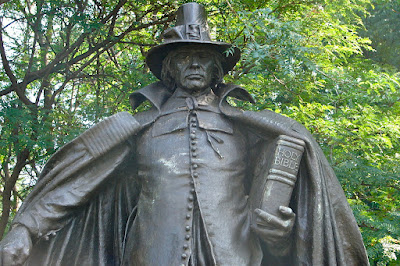
The famous sculpture below shows a Pilgrim with a "buckle hat." 


In fact, the buckle hat was fictional. Pilgrims never wore such an item, nor has any such hat ever existed as a serious piece of apparel. The sculpture was created by Augustus St. Gaudens in 1904. St. Gaudens summered in Cornish New Hampshire. FMI see this link here

The pilgrim buckle hat is featured on signs for the Massachusetts turnpike. 


This earlier controversial sign seen below has been retired. 


Now for the Dutch connection (everyone say hello to Julia and Joost). The Pilgrim Mayflower trail made an important stop in the Netherlands. FMI see these links here and here

Misguided Virginians think the first Thanksgiving was held at Berkeley Plantation. They even built a shrine marking the site. FMI see these links here


Finally for the important New Hampshire connection during the 19th century. 


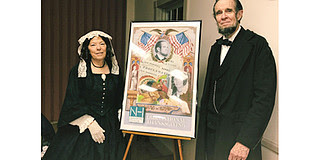
Pictured here are reenactors Sharon and Steve Wood playing Sarah Josepha Hale and Abraham Lincoln. See this link here for more details about their NH Humanities program. 

While I think we should all learn more about history from different perspectives, I echo Eric Meltzer's column in today's Conway Daily Sun (see link to his article here) in which he points out the problems with the Mass pike signs illustrated above. 

This is a holiday in which we can enjoy a couple days off work and focus on food, parade, friends and family. It has a much less commercial nature to it than many other holidays. 

By the way "wheels," my first car was a Plymouth Fury I got from my Grandfather.  

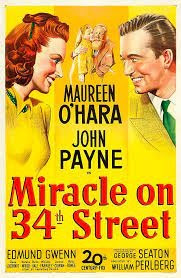
So, we will continue to do what we did in Florida, Delaware, Indiana and now New Hampshire. Our family tradition starts with breakfast and the Macy's Parade. Then after dinner, we will watch The Miracle 34th Street


FMI on the film see link here

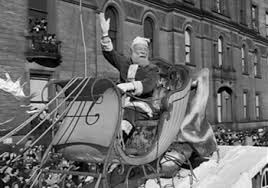
Our family Christmas holiday does not officially begin until we see Santa at the end of the parade in the film. 


On Black Friday (or Plaid Friday as some are now calling it), I will be presenting a program about the history of Thanksgiving for a local community group. I would be happy to do a free outreach program for other local schools and community groups as part of our seasonal "art of the harvest" programs. If you are interested in learning more contact us at the Conway Public Library's Henney History Room. 

Wednesday, November 10, 2021

This Revolutionary Event Was A Real Blast!


Posted in honor of Veterans Day and to prepare for future events.  

We recently attended a commemorative event at a Conway cemetery honoring a local veteran of the American Revolution that included this musket salute by a color guard in period costume.  

After five years of research, with help from The Sons of the American Revolution, The Daughters of the American Revolution and other local historians, the family was able to earn several memorial plaques for this veteran's grave.


The family wrote, "The Henny History Room held many documents that allowed us information to assist us, in our research of this lost patriot and for that we will always be grateful. We appreciate all the times you patiently dug out volumes, pulled files and maps and assisted us with the tasks at hand..."

We have also had a couple of other requests for information about the history and service of other local soldiers from the colonial and revolutionary war eras. 

It was a stirring ceremony and we hope to see many more patriotic events like this as we near the 250th anniversary of the Declaration of Independence in 2026 (only five years away). See our previous blog on that subject here

We have been reviewing our local online newspaper archive for how the Bicentennial of the Declaration of Independence was celebrated in Conway in 1976 (fifty years ago) and have found many examples to be followed. You can read some of the exciting things they did then at this link here

We are planning to offer free outreach programs on colonial and revolutionary period history to local schools and community groups that will include hands-on activities such as writing with a quill pen. 

We are also updating our online data base for cemetery records and as you may know the Conway Historical Society has published a guide with GPS coordinates to all the known cemeteries in town. Some of them are very hard to find. Let me know if you want to purchase your own copy or you can borrow a copy from the library. Of course we also have the library subscription of  the Ancestry software and would be happy to help guide you in your family history research. 

We also offer workshops on how to properly preserve family papers and photos. For more information contact us at the Conway Public Library's Henney History Room.