Wednesday, October 31, 2018

A Mystery for Halloween


What do you imagine this is? and what do you imagine is its connection to witches, Frankenstein, and Conway, New Hampshire?

You can find this mysterious image on our website at this link. This has been called a Druid's altar or temple. It can be found along the Thames in England not far from where George Harrison had his estate.The stone circle consists of forty-five granite megalithic stones that were once part of an ancient burial site. It is part of a pleasure garden that once belonged to Henry Seymour Conway for whom our town was named.


Also on the grounds can be found obelisks, fake Grecian ruins, gothic cottages, a rustic bridge, tunnels, caves, and a grotto reflecting the macabre and romantic tastes of the 18th century.


During Conway's 250th anniversary celebration a few years ago a lot of attention was paid to Henry Seymour Conway. Now we turn our attention to his only daughter. Here she is depicted as a witch (from Macbeth). See this link.


Here is another less Halloween-like portrait of her.


These images are part of a group of photos that had been gathered on the Conway family by a previous Curator, David Emerson, but had never been catalogued into our pastperfect online database. This image in the collection was a copy of this oil painting by Sir Joshua Reynolds, also in London's National Portrait Gallery. More at this link.

Not only was she the subject of artists, she was an artist herself. Even more rare for a women of the time, she was a sculptor.


Here is a portrait bust she did of a friend dressed as Thalia (the muse of comedy and idyllic poetry) now in the National Portrait Gallery, London.See this link. It is inscribed in Greek that "Anne Seymour made me."

She did self portrait now at the Uffizi that again in Greek text reads: ΑΝΝΑ ΣΕΙΜΟΡΙΣ ΔΑΜΕΡ Η ΕΚ ΤΗΣ ΒΡΕΤΤΑΝΙΚΗΣ ΑΥΤΗ ΑΥΤΗΝ ΕΠΟΙΕΙ which translates to "Anne Seymour Damer from Britain, made herself".


These inscriptions of ponderous, almost sad faces carved in cold marble make me think of Mary Shelly's book Frankenstein which is enjoying its 200th anniversary this year. Remember that novel begins and ends with death and destruction at the North Pole. There are also etymological coincidences (or not coincidence?) that tie to our own Frankenstein here in the white mountains. See this link.

While we are just having fun with words and images, Anne's real life was a combination "girl power" and love on the rocks. Note: we have an outreach program about "love on the rocks" in the White Mountains that includes tales of love, loss, murder, suicide, betrayal and abandonment.

More about Anne's life can be found at this link. It is poignant and seasonally appropriate to mention that she was buried with her sculpture tools and the bones of her favorite dog.

Have yourself a very happy Halloween!

Monday, October 29, 2018

Ashmead's Kernel - Just in Time for Halloween

The name Ashmead's Kernel is strange and mysterious. It kind of sounds like a novel title by Stephen King. Actually it is connected more to his wife Tabitha, owner of Pietree Orchard in Maine.

Ashmead’s Kernel is one of fourteen heirloom apple varieties we recently acquired at their orchard for a family apple tasting event.


They describe this apple variety on their website as "Tart and spicy, with pear and pepper notes" and conclude that "Ashmead's Kernel is an adventurous apple.


The Conway Public Library's Henney History Room offers a free outreach program to schools and local community groups on historic harvest activities including apples, pumpkins, corn and grain. 

Our collection of Samuel Bemis papers provides an interesting view into apple history.  See a link to this collection and our finding guides here. You can see his apple orchard in a number of photographs (click on the image to enlarge it).


Included in his papers is an invoice from Boston's Curtis and Cobb Company for the purchase of a cider mill for $25.


His papers also include detailed notes about the kinds of apples he grew and his experiments with grafting. These grafting experiments helped him win a silver medal in 1860 from the Massachusetts Horticultural Society for his "Collection of Apples."


Apples have played an important role in Halloween activities for many years.


Bobbing for apples started out as a divination or fortune telling game that was supposed to give clues as to what kind of luck you would have in marriage.


Winslow Homer’s print from Harper’s Weekly magazine “The Apple-Bee” shows you can have fun while working (peeling and stringing apples to dry over the fireplace).  It also includes fortune telling, throwing the apple peeling over the shoulder spell out the initials when they land.


Snap apple was another fun game for the romantically inclined.


I leave you now with an apple head doll that closely resembles one of our retiring volunteers. I will leave it to you and to him to make that connection.

As always if you have have any questions or comments, please contact us at the Conway Public Library's Henney History Room.

Monday, October 15, 2018

Happy Earth Sciences Week!

Did you know that this is “Earth Sciences Week.” Today, in fact, is National Cheese Curd Day and National Mushroom Day.

Did you further know that you can borrow “back pack” kits from the Conway Public Library to help you explore earth sciences in Conway and the White Mountains?


Created by Tin Mountain Conservation Center, and supported by L.L. Bean, we have back packs available on subjects such as birds, insects, mammals and so on. They include Items such as a compass, magnifying glass, binoculars, identification books, activity sheets, and maps.


Finally, did you know that the Conway Public Library's Henney History Room has a wide variety of resources for studying nature through history?

We do in fact, have several outreach programs we offer free to area schools and civic groups about the historical relationship between people and nature. We have programs that explore each season and cover topics such as ice harvesting in the winter, maple sugaring in the spring, farming in the summer and the "art" of the harvest for the fall.

If you would like to learn more, please contact us at the library.

Friday, July 20, 2018

Grover Cleveland papers - Conway to the Library of Congress

This week we installed a small display showing a few examples from the Conway Historical Society’s collection of President Grover Cleveland papers, before they make their move to the Library of Congress in Washington, D.C.


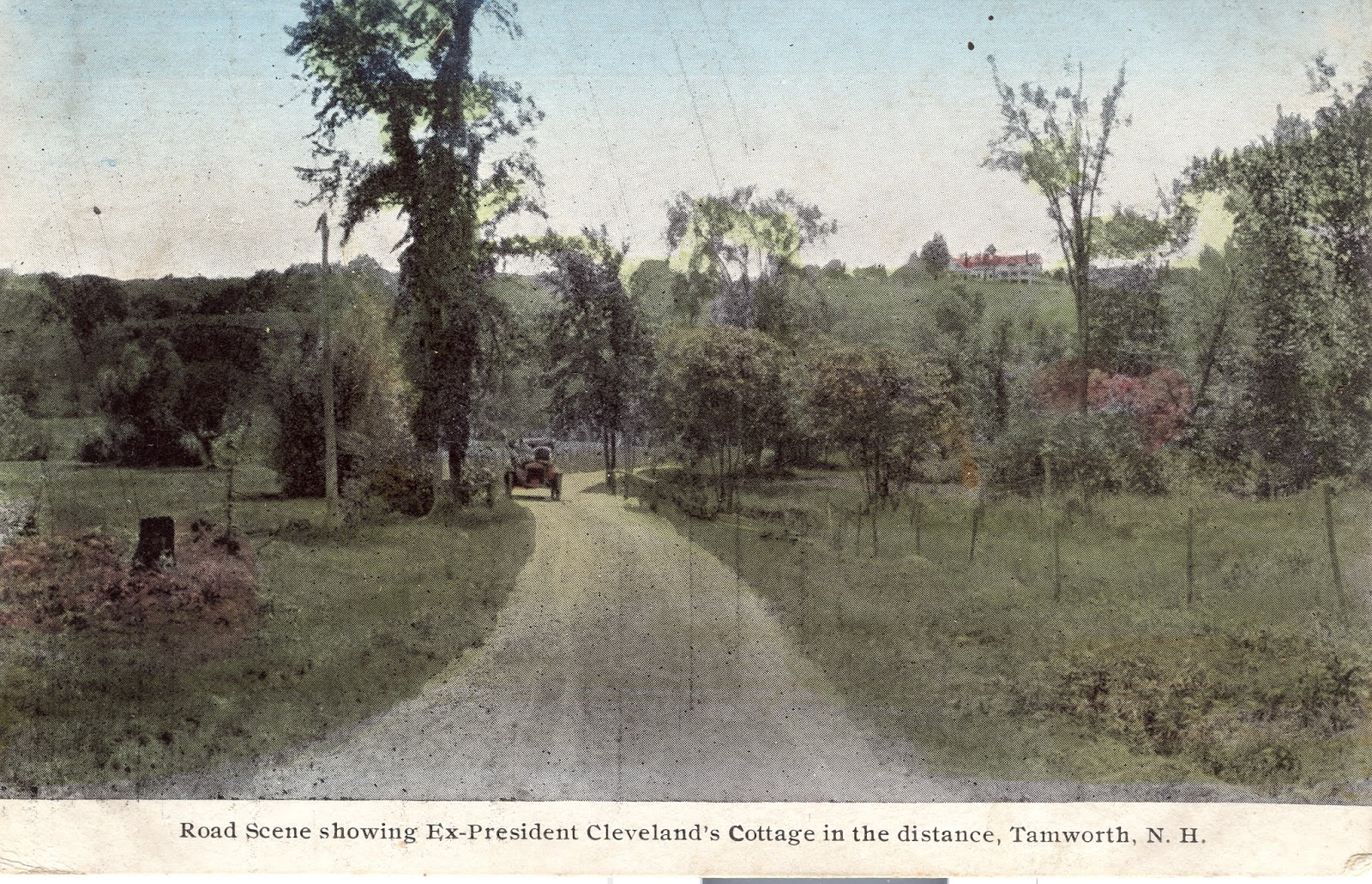
Cleveland had a summer home in Tamworth. Tamworth is one of the twenty-seven towns covered by the scope of the Conway Public Library’s Henney History Room as set up by Nella and Keith Henney. In Tamworth can be found one of the most unique Presidential monuments - not a sculpture, not a building, but instead a road and stone wall. Our exhibit features some pages from the fundraising committee for the project (click on images to enlarge them).


We have had quite a good bit of publicity on the project. Brian P. Wiggin has led the charge to preserve the papers and arrange to have them sent to the Library of Congress where all Presidential papers before Herbert Hoover are stored. Mr. Wiggin is a Trustee at both the Conway Public Library and the Conway Historical Society as well as a historian of both local and national history.


Please drop by and visit the display. We would be happy to talk with you about it.

Friday, July 13, 2018

Marvelous History


What's wrong with this picture? 


William Marvel does it again! In yesterday's Conway Daily Sun, he re-attributes the names of the boys in this picture from the Conway Public Library's Henney History Room collection. (click on image to enlarge it and read his argument).


Here is an image of the back of the original photo helping to see how the handwriting could have been misread.


As we reviewed in a previous blog what passes for history can change due to new insights or research such as that done by Mr. Marvel.

We welcome this kind of community involvement in getting our history correct. We invite anyone with an interest in history to join our volunteer group, for a part of a day, or on an ongoing basis. We have a large back log of items to scan, research, and post in our online collection. We have many photographs that have unidentified people in them. Perhaps you could give some of these anonymous faces a name!


Thursday, July 5, 2018

Happy Barn Day!


I hope you are all looking forward to celebrating the next National Barn Day this Sunday, July 8th, 2018. As I am sure you all know, it is always the second Sunday in July.

One of the many websites about Barn day suggests you “Celebrate Barn Day by driving out into the country to see as many barns as you can. Really get out there and barnstorm—literally. Take note of the different types of barns you can find. Take photographs!”

If you do take photographs, or have any old photographs or archival materials on old barns, we would be happy to collect or copy it for our collection to preserve and share with future generations.

We can also help you plan your barn day itinerary with books and historic photos from our collection.

If you start on Greenwood Avenue at the Conway Public Library head west to Pleasant Street.

If you look south or west you will see good examples of barns “connected architecture” outlined in Thomas Hubka’s “Big House, Little House, Back House, Barn” available for checkout at the library.


Here is a sketch diagramming the basic layout of these types of buildings, common throughout the Mount Washington Valley.


On the south west of the “four corners” is the old Abbott Dairy barn. You can still see part of the original track for the hay fork. Click on the picture to enlarge it and check out the really cool old truck.


From here you can head up along West Side Road which is like a museum of barns. Soon you will pass the old Allard Farm, once the site of the largest elm tree in New Hampshire.


Further up on West Side Road you will pass the "Smiley Face" barn seen above. You can also see an interesting potato barn built into the ground.

From West Side take River Road over the Saco back to Route 16. You can take a short detour north and check out the  old Whitaker barn at Whitaker Woods. 


A bit further north the old Bigelow barn ...


 ...has been turned into an organic grocery store and restaurant.


This barn has a distinctive style roof treatment called a Jerkinhead. 


 Further down Route 16 you will pass the Red Barn Outlet.


 We explored the photo above in detail in a previous blog here.


 Another barn you can explore is the Merrill Farm barn before returning to the library.


Have fun!

Friday, June 29, 2018

Summer Blockbuster


No... it is not "Jaws" or "Star Wars" or "Jurassic Universe." It is the most recent display from the Henney History Room near the main entrance of the Conway Public Library.


The exhibit focuses on summer traditions. 


In the center of the top shelf is the book "Summer on Foss" by Joyce Blue. This book examines the many summers enjoyed in Eaton on Foss Mountain by Keith and Nella Henney, the founders of the Henney History Room. Adorning the top of the book are noise makers, sunglasses and a patriotic rubber duck symbolizing the Old Home Weeks, bean hole suppers, parades and Ducky Day fundraisers of the summer. 


To the left on the top shelf is a children's book on "Mowing." Children's books provide a wonderful exploration of historical topics. This cover shows the use of "heavy horses" pulling a mowing machine. It is a great insight into changing technology and farming practices. See our previous blog about the changing roles of "old iron." 

Earlier today, as I drove by the Saco Valley Overlook just before heading into North Conway I stopped to view the progress of haying or mowing on a big field across the Saco River.


The river in the middle is now popular for kaying. The beach on the right is for summer sun bathing and picnicking. One can often see a Heron fishing in the backwaters near the beach.

In the far distance you can see the remains of older, now abandoned, fields running up the slope of the Moat Mountains, now grown over and returning to forest. Hidden up on that slope is the nearly forgotten Thompson's Falls discovered by our own local artist Benjamin Champney.


I could still see some patches of snow on Mount Washington and bits of the ledges with long forgotten, but once popular tourist attractions of caves and cathedrals, now popular for hiking and rock climbing.  


The overlook was established in 1973 by the Pequawket Foundation in memory of Robert H. Kennett in honor of Mrs. Harvey D. Gibson (click on pictures to enlarge them).


The hay cut from these fields will be stored in barns along West Side Road on the other side of the river. To get to West Side Road from the Conway Public Library you can pass through a covered bridge and picnic in another nearby one. Yesterday I drove along West Side Road watching hay and strawberries being harvested. You can check out our previous blog about strawberries at this link.

Above the mowing book is a picture of folks swimming under a covered bridge.


We will be doing more research on swimming holes near covered bridges for an upcoming WMUR Chronicle program.  Another part of the display celebrates the patriotic fever of the Fourth of July. A miniature rustic bench reflects a popular motif used by T.E.M. White and Chase in their photography.


Historically, summer was the key to growing food for New Englanders to survive the rest of the year.
Sweet corn for example supposed to be "knee high by the Fourth of July."


Settler's Green outlet stores now occupies what was once the White Mountain Airport where Wylie Apt would provide aerial tours of Conway and the White Mountains. The next shelf displays three summer related books by the late Donald Hall (September 20, 1928 - June 23, 2018).  


In the foreground is an assortment of images used to promote farming and tourism.


 Below are some illustrations from a tourist brochure


Pictures include Echo Lake and the ledges (now part of a State Park). The location of Cathedral cave and Pitman's Arch rock formations are known to only a few now.

On the bottom shelf, is a map known as the Idler map. It is a wonderful resource with many interesting details.


It shows the location of "White Photographer," and the Whitaker Bros house and barn. The house is gone, but the barn remains. On the map you can see the foot paths that are now Whitaker Woods. 


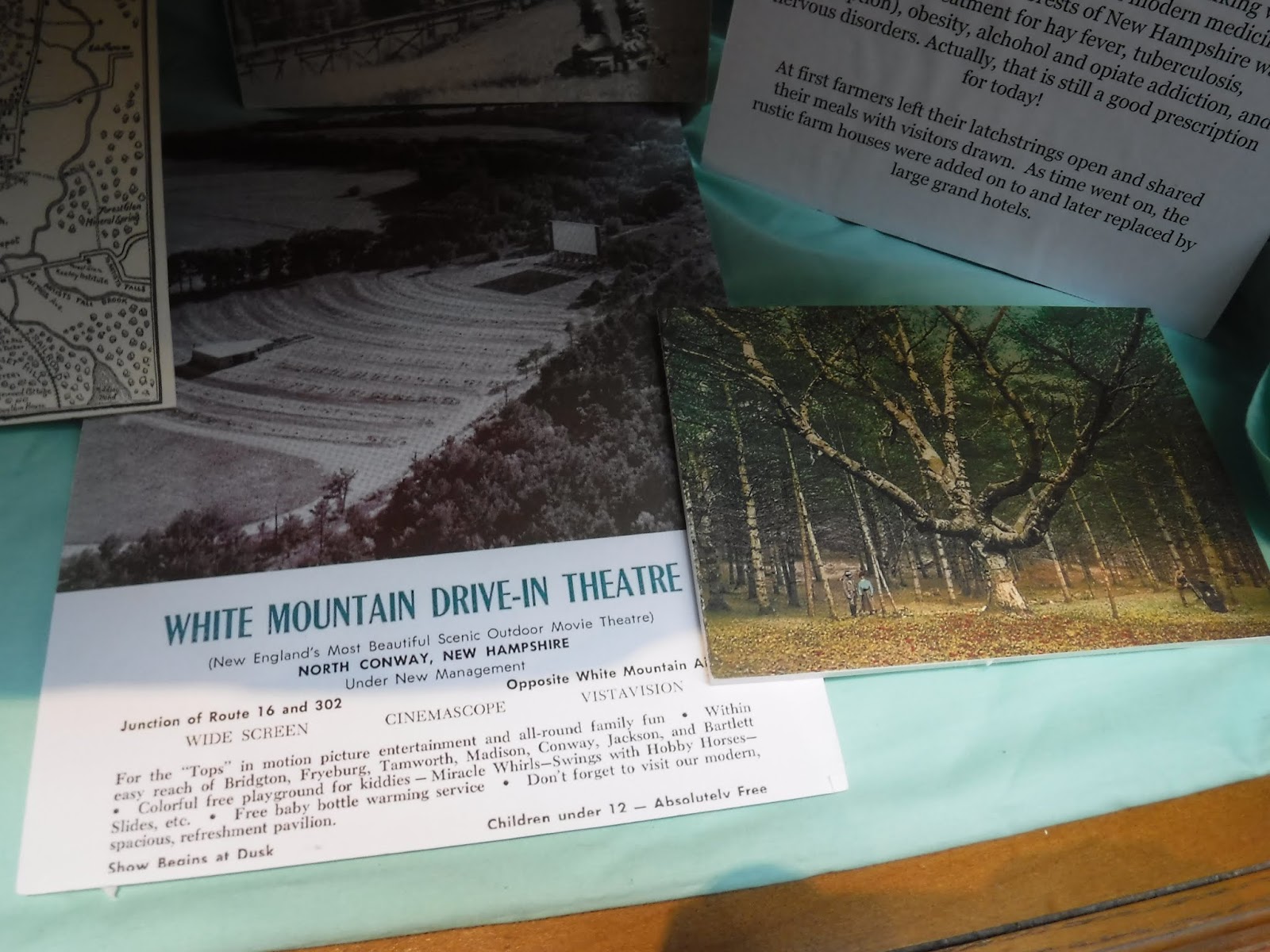
The bottom shelf also shows the old Drive-In Theater, now a housing development and the once famous Wizard Birch that was in Cathedral Woods near the Abenaki Gift Shop.  For more details on summer in the Conways and the White Mountains please visit the Henney History Room at the Conway Public Library.