Monday, June 27, 2016

Confirmation

We had confirmation recently that this portrait on display at the Conway Public Library was by a deaf itinerant artist John Brewster. See this link.


For a unique perspective on it see our previous post

To follow another connection to the deaf community follow the threads in another recent post, and look into the author of the poem about the universe, Henry Baker.


New Donation


Recently, we had a surprise walk in donation of a bound 1902 map of the White Mountains. We love these kinds of surprises! We already have a wall mounted version of this map that originally sold for $2.50. This one is a bound and folded cloth mounted version that originally sold for $1.50. It is interesting to compare the two versions. It is also fun to look at bits of the lost historic landscape such as the post office in Green Hill and the “village” of Conway Street.


Enjoy!


Questions, just ask!


Monday, June 13, 2016

Sam'l Bemis his Book


Last week we focused on the context, the physical aspects of this little memo book. We explored the paper, the laid lines, and the watermark.  
 
Now we will look at the content found within the booklet itself. As you can see, the text reads “Cambridge June 11th 1776
Saml Bemis his Book
 
This use of use of speaking in the “third person” is a common historical phrase.  


Then it reads, "Doctor Bentlet wrote a preface to Milton. It probably should read Dr. Bentley who wrote a preface to an edition of Milton's poetry. There are many references to poetry throughout the memo book.
 
There are also many references to more practical, technical subjects.
These pages below show a carefully delineated illustration of watch parts. This Samuel Bemis like his son Samuel A. Bemis was a watch maker. The text on the left page reads in part,
 
For a moon clock
The moon wheel must be 7 ¾ inches
In diameter it hath 118 teeth
Day of the month wheel 3 inches diameter
It hath 62 teeth


You can also find
“Rule for making Semet” Perhaps "Cement" for tooth fillings?
Rule for making silver soder, Rule for making gold soder
and many other practical notations.

Peppered throughout the text there are many references to classical poetry, the bible and Shakespeare. While these references may have been familiar to people of the late 18th and 19th century, they are not in as common use today. With the help of the internet we are able to track down some leads.

The quotation below for example,
Come forth, O Man, yon azure Round survey,
And view those Lamps which yield eternal Day.
Bring forth thy Glasses: clear thy wond'ring Eyes:
Millions beyond the former Millions rise:
Look farther:--Millions more blaze from remoter Skies.
 
A poem intituled (phonetic spelling) The Universe


We can find more about this fascinating poem and its author here.
See if you can track down more of these poems and please contact me through the comment section below.


Monday, June 6, 2016

For One's Country

There is an interesting secret hidden within this new discovery found in the Samuel Bemis papers. This memo book is from the first Samuel Bemis, the father of the now famous dentist and photographer.


Let's examine it. It is made of 12 sheets of paper folded and sewn together into a booklet.
Each sheet of paper measures 6x8 inches so when folded and sewn together, the booklet is 4x6 inches, small enough to fit in a coat pocket of the time period.


Here you can see the threading pattern used to bind the booklet.


When placed on a light table, you can see the distinctive pattern known as "laid" paper that helps to identify its age.


What you are seeing are the impressions made by the wire screen used to make the paper. A watermark or company logo was also embossed on each sheet of paper. These watermarks also help to when and where the paper was made. However, as the original fairly large sheet of paper was often cut into various smaller sizes for different size booklets, it took us a number of pages to puzzle out the watermark. Here we can see a part of the overall design and the word "Pro."


Another part of the design can be found on a different page and it includes the second part of the main phrase, the word "Patria" 


So now we have the complete phrase, Pro Patria, translated from Latin it traditionally means "For One's Country" part of a larger famous phrase from Horace's Odes poetry,  

Dulce et decorum est pro patria mori is a line translated as: "It is sweet and glorious to die for one's country."

 
Can you see another component of the logo, what seems to be the head of a person? wearing some kind of helmet?


Revealed by light, the pieces fall into place, 

However, not all of the watermark can be found in the booklet, so have to check references, in this the case the internet
We can find ...
 
Without looking it up, this upside down part of the watermark would never have made sense to me, however, with the complete image, I can then see this is the bottom right section of the watermark.


I could not find the bottom left section of the watermark anywhere in the booklet. But here is what is would look like.


Now look back up at the photographs and you can see the hand of the lion holding a curved sward, Brittanica with her helmet holding a staff, etc.

This is the kind of stuff we do for fun in the cellar of the Conway Public Library where the Henney History Room is located. If you want to join in the fun, become a volunteer! To learn more about anything in this blog comment us or contact us at the Conway Public Library.


Tuesday, May 31, 2016

Day After Memorial Day

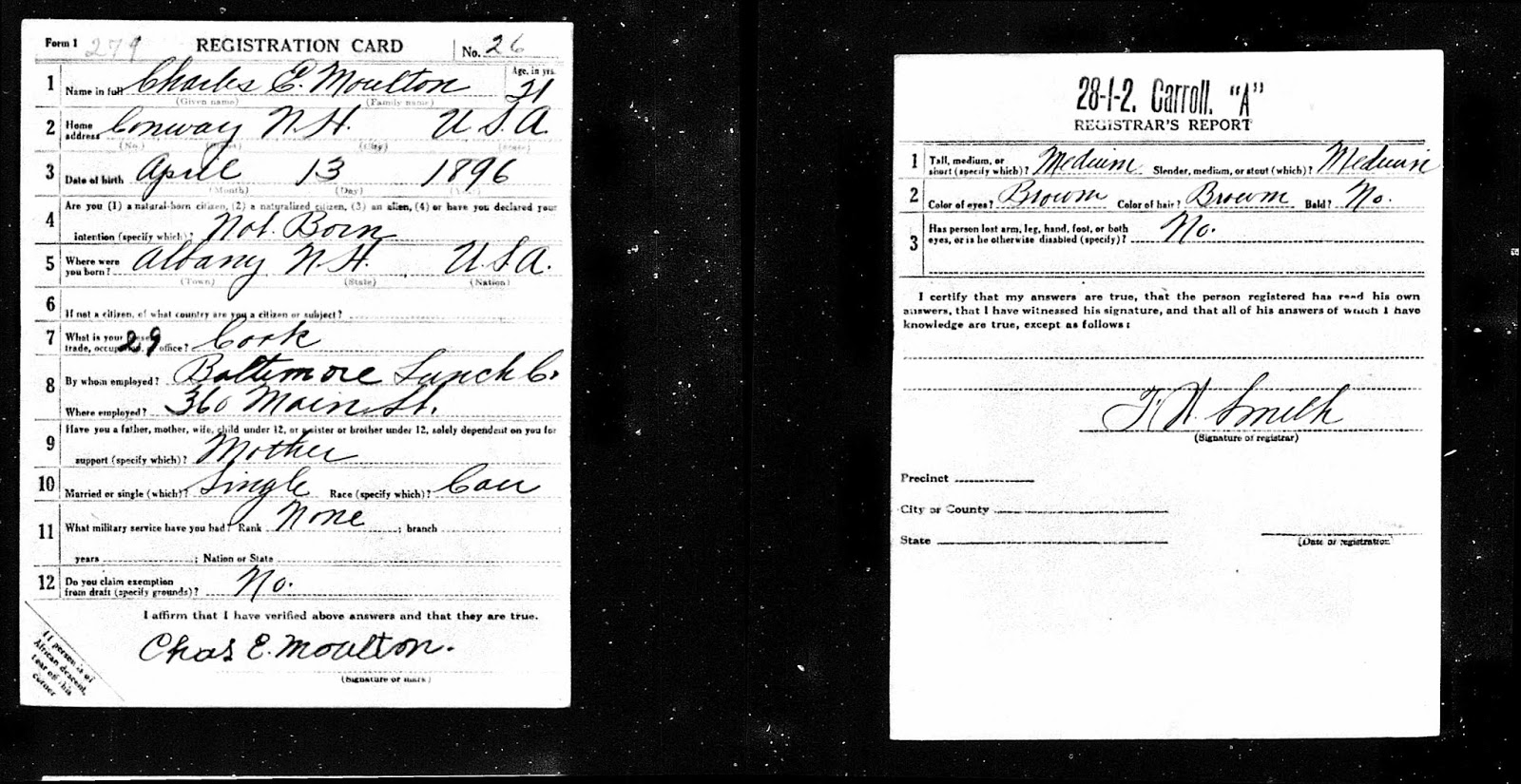
I dropped by the Conway Cemetery this morning, the day after Memorial Day, and was pleased to see the site well cared for and the stones decorated with flowers, flags, and markers for veterans. As part of our ongoing research into Conway’s memorials, I wanted to share what we have found so far about one of the veterans listed on the Conway Honor Roll on the library grounds.


There are two names with stars next to them indicating that they died during their time in the service. This is a good example to point out both the strengths and the limitations of the resources available through the Conway Public Library. We have a special library edition of Ancestry.com with access to a vast collection of documents.

The photo below is from the Find-A-Grave website for Charlie E. Moulton.
The death date for him on the stone (and other records as we will see) is 1918 but is recorded as 1908 on the Find-A-Grave website. That is an easy mistake to make and we will follow up and fix that.


It is also a little tricky to find this stone. While it is in the location on the website (plot A1), its actually carved on the back (facing west) of another stone marked Cooledge that faces west like most of the other stones. Some details about Charlie Moulton and his family can be explored in the 1910 census (click on the image to enlarge it).
 

His father Lumen was a finisher at the spool mill and his mother was named Carie, spelled Carrie on the gravestone. The census also tells us that many of his neighbors also worked at the spool mill or the saw mill. From the draft registration card we can see that he was born in Albany, NH on April 13, 1896 and at the time of his draft he was a cook.


Following this link we can see
a Charles Edward Moulton, coalheaver, New York division, died April 20, 1918 at marine hospital, Stapleton, NY from pneumonia, next of kin, Mrs. Carrie Moulton, Conway NH. Perhaps this was the so called "Spanish Flu" that killed millions in 1918? More on this and the other folks on the memorial later. 


Sunday, May 22, 2016

Wars and Rumors of War May 1916

One hundred years ago this month. Remembering one war while trying to avoid another. (Note: click on images to enlarge them)

While Conway's residents received little actual news about the war raging in Europe, the Reporter's May 4, 1916 editorial page opined on President Wilson's diplomatic efforts to avoid war with Germany.
 
Germany had been sinking ships and according to the paper, Wilson was writing "yet another note" to complain and ask them to stop. The writer commented ironically and dramatically that Wilson "gave Germany four days to make a reply, and he said he really meant it. But the Kaiser didn't believe it and has taken his time."
 
The implication is that Wilson's efforts were useless. The editor concludes sarcastically that, it is "Pretty near time Wilson was writing another note" suggesting that Wilson will continue doing paperwork while Germany destroys ships and kills people.
 
Wilson's inaction (other than writing complaint letters) is contrasted in a paragraph below on England's problems with the Irish insurrection on the home front, the surrender of 10,000 troops in Turkey, the loss of a battleship and 25,000 men (wonder why the battleship takes priority over the loss of life?). In any case, the "indomitable spirit" of Britain in the form of "Johnny Bull" is contrasted sharply with Wilson's lack of effective action.


The criticism of Wilson continued in the May 18 edition of the paper with the editor taunting the "school-teacher President" with his continued intellectual efforts to stop the German war machine.


Also in May, there is news about the "Usual Exercises for Memorial Day." The focus is on the Custer Post of the GAR, a civil war era veteran's group. The article points out that the ranks grow thinner as the veterans of that war age and pass on. The commemoration began the Sunday before the holiday with church services.  
 
Memorial Day proper would begin when "comrades and others appointed, will decorate the graves of soldiers..." followed by an assembly at Red Men's Hall in Conway at noon for a dinner provided by the Women's Relief Corp. This would be followed with a parade that was to include a long list of other fraternal orders.
 

Continuation of this article


May 31, 1916 will see the Battle of Jutland, but we won't hear the news until June. Stay tuned to see how that is reported ...
 

Saturday, May 14, 2016

Armed Forces


Did you that May is Military Appreciation Month?
It celebrates a variety of military related events throughout the month including next Saturday's Armed Forces Day and ending with Memorial Day Weekend. 


Located on the north side of the library is the "Conway Honor Roll" intended as "A Tribute to Those Who Served in the World War. 1917-1919" This is what we now think of World War One and in 2017 we will remember the 100th anniversary of the United States entering that war.


To prepare for this anniversary we are going to research all of the names on this plaque. (click on the image to enlarge it so you can read the names)
We would like your help in this project. If you are related to any of these folks please comment us below (this means you Brian Wiggin!)
We would love to make copies of any photos you have and learn about stories you can relate.
We also are looking for volunteers to help research the names through our Conway Library subscription to genealogy databases and files and books.

There is at least one women's name on the list and we would like to learn more about her.
We have access to the World War 1 draft registration cards. (click on the image to enlarge it so you can read it). From this card we can learn that Bobbins was born in, and still a citizen of, Russia. He was a laborer at the Conway Lumber Company. He was single, of medium height, and stout build.
It appears he was illiterate as he made his mark with an x and had the registrar witness it.


I recently visited the Conway Village Cemetery to see the grave of Charles E. Moulton, one of the two names with stars next to them indicating they died in service. As part of this project we could photograph and record the location of these veterans.
Let's honor these brave people who defended our liberty by remembering who they are.