Monday, February 22, 2016

Happy Birthday Mr. President


By George I remember when we made much more of a fuss over George Washington's Birthday!
There were pageants and parades and all the kids would dress up and the adults would dance.

Did you know that Conway played a small part among the many monuments and mementos (including one of Washington's sets of dentures above) celebrating our first President? In Conway, Washington was a doll! Actually both he and Martha were part of the doll collection commissioned by and sold through the Yield House.


The kits were sold with the parts to assemble, but you had to make your own costumes, so there are many different variations that can be found for sale now online through Ebay, Etsy and so on.


Kind of a "do it yourself" activity. 


Sunday, February 21, 2016

February 1916


More one hundred year old news from the Conway home front during the Great War. A big event one hundred years ago this month was the showing of the film, The Birth of a Nation at the Bijou Theater, now the Glass Graphics building on Pleasant Street.


The Reporter, February 3, 1916, p. 8
 
 
The movie purported to be "war as it actually is!" with a cast of 3,000 horses and 18,000 people. Only in this case, the war featured in the film was the American Civil War.
 
Another war film from February 1916, The Nation's Peril was presented at the Masonic Theater in North Conway. Their big battle scene only involved 3,000 people but was still said to be sensational and thrilling with explosions, sinking ships, and artillery bombardments of an American town by an invading foreign power. It warned of the dangers of pacifism and inspired a nationwide fund-raising campaign for the Navy to build more battleships.
 
Another type of fund raising appeal also showed up in this month's newspaper focusing on civilians caught in the crossfire. 


The Reporter, February 10, 1916, p. 5


The Reporter, February 17, 1916, p. 3
 

The big local events were the various celebrations of Washington's Birthday. (Oh yeah and Gray's Inn in Jackson burned for the third time in eight years).


The Reporter, February 24, 1916, p. 1


The Reporter, February 24, 1916, p. 1
Here is a menu from one of the celebrations at the Russell Cottages, now home to a ski club in Kearsarge village. I know what Nabiscos are, but what are Martha Washington fritters?


The Reporter, February 24, 1916, p. 1


A final word on the war. Some of the class system attitudes are similar to what one would expect in episode of Downton Abbey


The Reporter, February 24, 1916, p. 8
 
It's not just a job, it's an adventure.


Monday, February 15, 2016

Sunset Pavilion

What's old is new ...
... at least to us!

We recently received donations of several menus related to the Sunset Pavilion once located in North Conway.


September 12, 1884
M.L. (Mahlon Lee) Mason, Proprietor
Sunset Pavilion

It's interesting to compare an online photo that is very similar to the engraving on the cover of the menu. See: https://ellensquilt.files.wordpress.com/2015/01/sunset-pavillion-11116420140610115137_001.jpg 
You can actually enlarge the image to read the sign on the building. 


Another picture shows a boardwalk lining the roadway.


The menu from 1884 lists stuffed cod, boiled ham with Champagne sauce, corned beef, fowl, pork, roast sirloin, lamb, chicken, and cheese for desert. 


 The donation also included another printed dinner menu from The Sunset
dated six years later, September 2, 1890. 


You can see a view of White Horse Ledge that used to be able to be seen when the fields were cleared. On the right inset can be seen the "new pavilion music room" which is now the Eastern Slope Playhouse. 


The menu includes printaniere or "spring time" soup, (typically includes peas as the main ingredient) and other fresh vegetables, fish, fowl, roast beef, and minced lamb, and macaroni au Gratin (basically macaroni and cheese). 


Monday, February 8, 2016

The North Conway Academy


This wonderful piece of ephemera was recently donated to the Conway Public Library. It adds greatly to understanding of local history, especially when studied in context with other items already in the collection.


We have never seen this kind of detailed information about the operation of the Academy.


With its distinctive four pronged tower, the old Academy building is useful in identifying North Conway in White Mountain Art (click on images to enlarge them).


Click on this image and you can see the Academy building in this Currier and Ives print. Contact us for more artworks showing the Academy building and visit us at the Conway Public Library to see a large oversized mural of a very famous print showing the Academy.
 
Organized in 1828, the Academy continued operation until the building was torn down in either 1874, or as some other sources say, 1885. The area later became the site for the North Conway Community Center. That building is now planned to become part of the NH Ski Museum system and a new community center has been built near by.
 
The newly planted trees along the boardwalk in the background have been traced in photographs through the years, and a few of the trees remain.


Another view of the Academy building in our online collection.


Recently we travelled through Henniker, NH and saw that they had a very similar Academy building. This one now serves as their local historical society museum. More research to be done here!


Saturday, January 30, 2016

...let slip the dogs of war.

William Shakespeare, Julius Caesar


A copy of Shakespeare's first folio with these immortal words will be on display at the Currier Museum later this year to mark the 400th anniversary of his death (see http://www.currier.org/exhibitions/first-folio-book-gave-us-shakespeare/ for details).


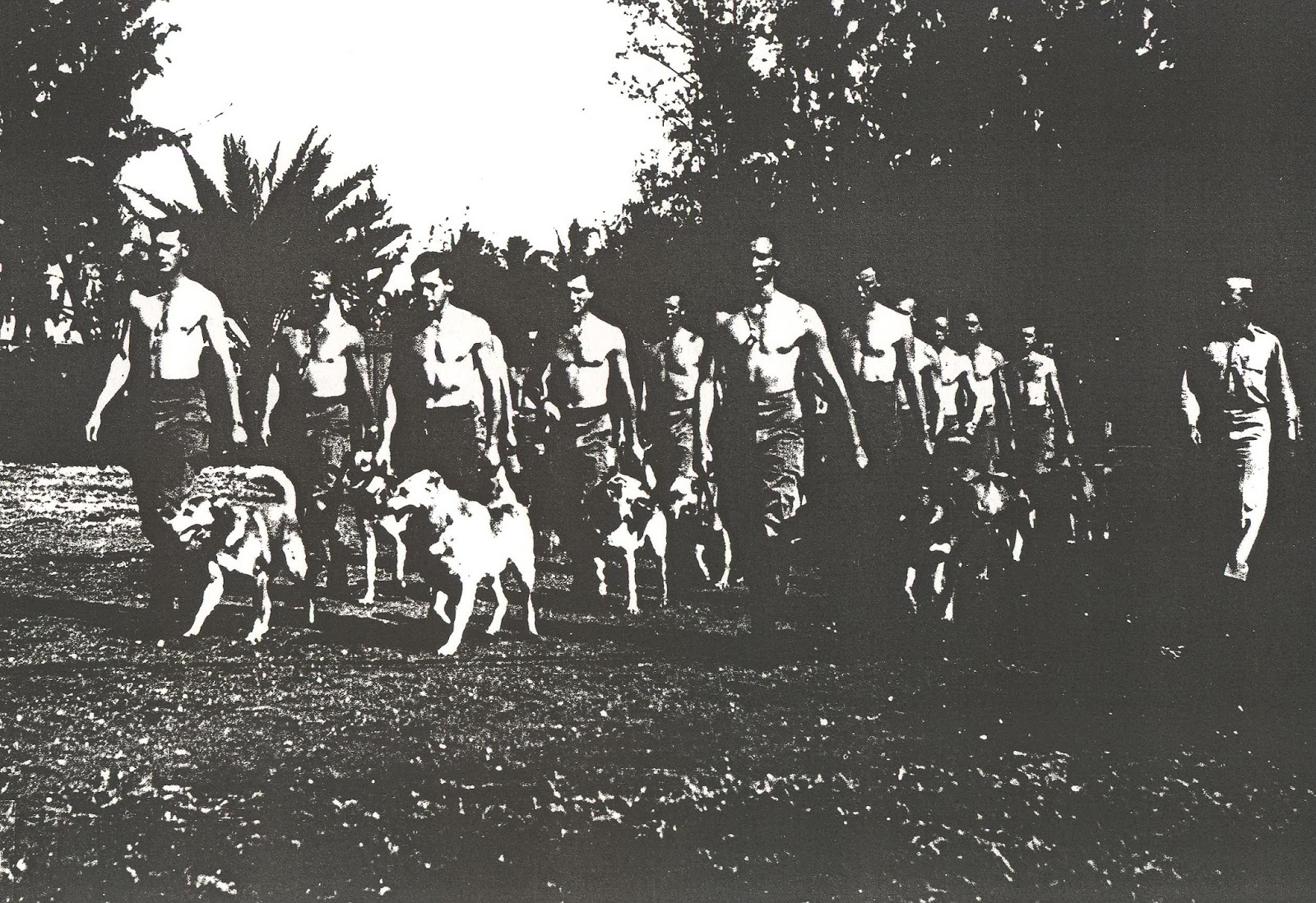
Dogs in warfare have a long history starting in ancient times. The photo below is from a fascinating microfilm that we have at the Conway Public Library's Henney History Room.  


 It documents the use of military dogs during World War Two in both Europe and the Pacific.


  Many of the pages are marked "secret" although they have since been declassified. Click on the pages to read them. The page below details an interesting encounter in which "One of the patrol scouts, who spoke German fluently, went forward to investigate the alert, when he was challenged by a German sentry, he pretended to be a German soldier and engaged the sentry in conversation."


Local skimeister, Hannes Schneider's son also had a similar experience according to notes in our vertical files.
 
In this case, "The sentry became suspicious and fired on the patrol. In the skirmish that followed Cpl Brown was slightly wounded on the knee by a fragment of an enemy hand grenade."


Later in the report, credit is given to several of the dogs in the unit. Buddy was praised for working very well while the patrol withdrew under heavy machine gun fire and "when it was necessary for Cpl Brown to crawl, Buddy automatically crawled with him without command." Messenger dogs Sailor and Pal carried map overlays one and a quarter miles making a record for time for a successful run by a messenger team.
 
This report was about a unit attached to the 87th Mountain Infantry Regiment, part of the famous 10th Mountain Division, bivouacked in Vidiciatico, Italy.
Some of the war dogs were trained at the Chinook Kennels in Wonalancet, a village in Tamworth, New Hampshire.
 
Charger, pictured below, was a Chinook mascot for the first operational Chinook helicopter unit in Vietnam in 1966. He was a gift of the employees of the Vertol Division, Boeing Company.


Chinooks are New Hampshire's State dog breed.


Here they are "with bells on" and ready to roll.


Wednesday, January 20, 2016

A look back ...

... one hundred years ago to January 1916 … as viewed through the lens of Conway’s local newspaper of the time. The Reporter was published each Thursday for 3 cents a copy or you could get a subscription for $1.00 per year if paid in advance.

Things have changed. For example, today’s local newspaper is actually cheaper - its free now.
 

The Reporter, January 27, 1916, p. 5


Prices were much cheaper for most items. A dress priced regularly at one dollar dress was on sale for 79 cents. Cod liver oil was 75 cents a bottle.

On the other hand, the bank offered 4% interest on savings deposits. That would be a fantastic deal in today's economy.

 The front pages of January 2016 have focused a lot on national politics. While 2016 is the 100th anniversary of the NH primary, there was very little on the front page about national politics in 1916 or for that matter much of anything about the war raging in Europe. 

 Instead the largest page one article for the January 6, 1916 issue covered the debate about a bequest for the North Conway Public Library with Dr. Schouler and later Harvey Dow Gibson giving their opinions.

 The war was not mentioned in the month's first issue until page four, and that was more of a social column about Parisians going to the forests for vacation as the seaside resorts have been taken over by military authorities. The month's second issue also referred to the war on page four in reference to Wilson wasting his time writing complaints against Germany's destruction of our ships and the problem of the “war economy” cutting down budgets for libraries to buy books.

The first visual reference to the war comes in the 4th issue of the month on the 5th page in the form of an advertisement. (see picture above). Using the image of a soldier and comforting military type phrases, we are told that Rexall laxative tablets, available at Pitman Pharmacy, North Conway are ...

“Standing Guard Over the Whole Family” and this product “Protects every member of the family from Constipation - the enemy of good health” This Pitman family was related to the then famous Pitman's arch tourist attraction on West Side Road. Never heard of it? Give us a call or check it out on our online history collection.

More than half the regular front page was basically local gossip and social news.  On each issue's front page, the column on the far right was for the “Conway” column with the subtitle, “What the People are Doing in Busy Conway” Like today’s facebook or twitter these social columns were short and sweet and laced with advertisements. So here is a bit from the past.

 
Schools began Monday last with the same corp of teachers.
Edward Davis returned from his visit to Massachusetts on Monday.
Mrs. Warren Bly and little daughter returned from Memorial Hospital last Friday.
For Sale - Green hard wood, fitted to stove. Inquire of John G. Lucy, North Conway


Again, like facebook and twitter, you needed to understand the code of abbreviations. Today it's OMG, and WWJD? The cryptic codex of a century ago included IOOF, K of P, GAR, CRC, OES, DAR, D of P, IORM. I will give a free copy of Hounsell’s history of Conway to the first person who comments me with the correct answer to these abbreviations.  

Here is a hint. Most of them are related to fraternal and social organizations.

From the text and the ads, you can see that health was a major issue. In the case of cold feet the solution was not a pill, not a high tech device, but instead a hot water bottle, available at Stone the Druggist opposite the train station in Conway.


The Reporter, January 13, 1916, p. 8


It was also a time, when things such as shoes and watches were repaired instead of simply tossed and replaced. We have very few repair shops in town anymore.

The Reporter, January 6, 1916, p. 2

Do you know where the Pequaket House was? I'll give you a hint. It is now a very erudite location.
Semper Fi!




Sunday, January 10, 2016

Frozen


After a long wait, winter has finally arrived. We have had a wild weather ride this winter and it looks like the ping-pong temperatures will continue with warm to frigid and back again. The recent extreme cold and snow made me think of the Conway Public Library's Henney History Room collection related to polar exploration.
 
Earlier this week the truck I was driving to work stalled out, stranding me in 20 degree weather. That made me think specifically about the challenges of technology in the cold weather and the often tragic and dangerous history of polar explorations especially the problems they had with airplanes and snowmobiles. Did you know if it were not for White Mountain local Arthur Walden and his dogs, the Byrd expedition to the south pole would have failed?


The Conway Public Library’s Henney History Room has some great resources on early polar explorers. Due to our sometimes extreme weather and closeness to metropolitan areas, this area served as base for many famous cold region explorers and adventurers such as Greely, Peary, Byrd, Walden, Ricker, Clarke, Seppala and of course the dogs, Chinook, Kim, Ningo, Igloo, Balto, Rud, Yard, Kip, Ling, Riki, Tiki, Tavi, Togo and Tug.  


Some of this history will be revealed at an upcoming outreach program at the Gibson Center later this month. If you would like to schedule one of our outreach programs for your school or club please contact us.
 
We are also working on several “frozen” type projects including a student history fair on explorers, a film on dog sledding, and a project with the NH Folklife Program on making dog sleds.


Hope to see you on the trail!