Saturday, January 30, 2016

...let slip the dogs of war.

William Shakespeare, Julius Caesar


A copy of Shakespeare's first folio with these immortal words will be on display at the Currier Museum later this year to mark the 400th anniversary of his death (see http://www.currier.org/exhibitions/first-folio-book-gave-us-shakespeare/ for details).


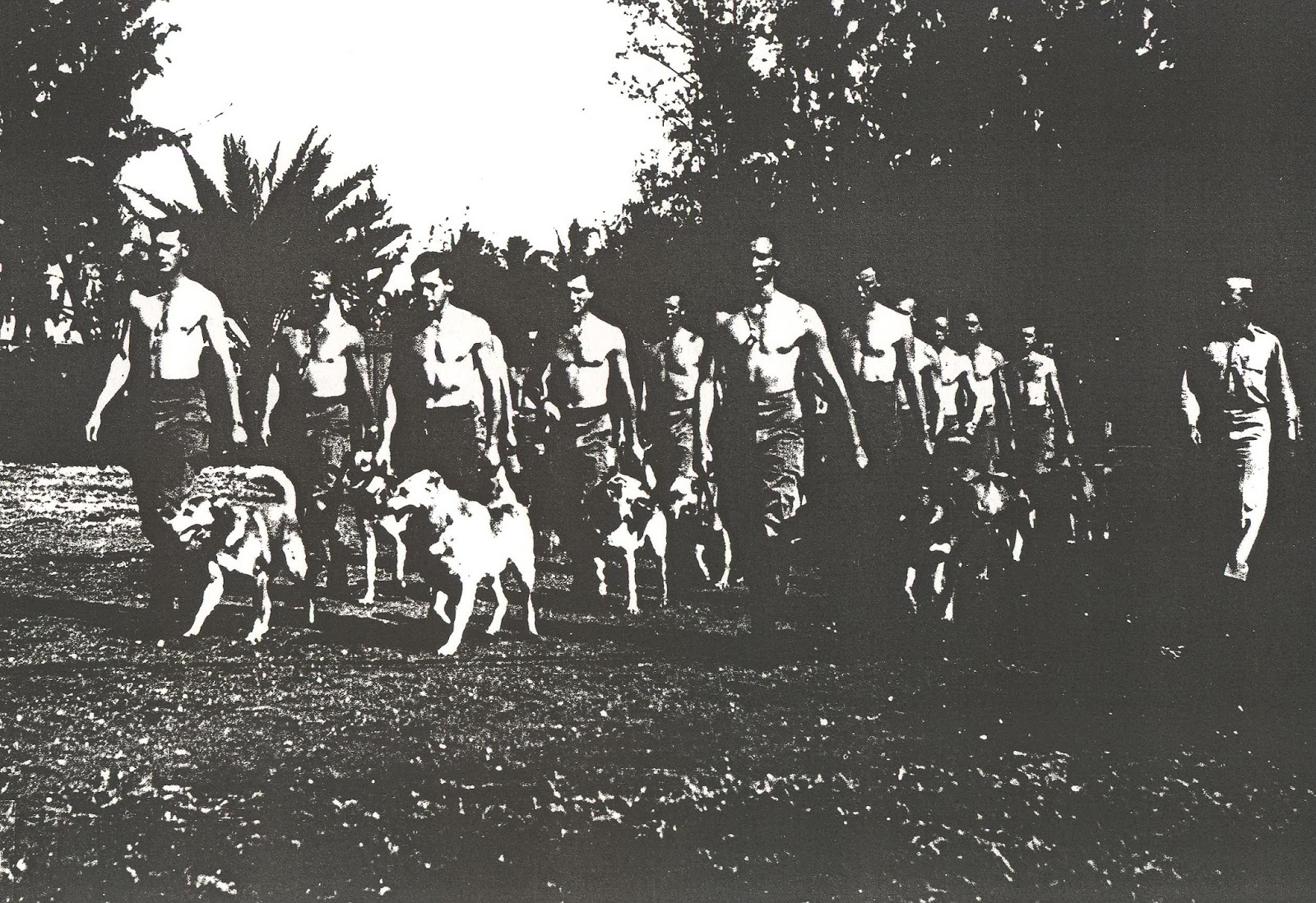
Dogs in warfare have a long history starting in ancient times. The photo below is from a fascinating microfilm that we have at the Conway Public Library's Henney History Room.  


 It documents the use of military dogs during World War Two in both Europe and the Pacific.


  Many of the pages are marked "secret" although they have since been declassified. Click on the pages to read them. The page below details an interesting encounter in which "One of the patrol scouts, who spoke German fluently, went forward to investigate the alert, when he was challenged by a German sentry, he pretended to be a German soldier and engaged the sentry in conversation."


Local skimeister, Hannes Schneider's son also had a similar experience according to notes in our vertical files.
 
In this case, "The sentry became suspicious and fired on the patrol. In the skirmish that followed Cpl Brown was slightly wounded on the knee by a fragment of an enemy hand grenade."


Later in the report, credit is given to several of the dogs in the unit. Buddy was praised for working very well while the patrol withdrew under heavy machine gun fire and "when it was necessary for Cpl Brown to crawl, Buddy automatically crawled with him without command." Messenger dogs Sailor and Pal carried map overlays one and a quarter miles making a record for time for a successful run by a messenger team.
 
This report was about a unit attached to the 87th Mountain Infantry Regiment, part of the famous 10th Mountain Division, bivouacked in Vidiciatico, Italy.
Some of the war dogs were trained at the Chinook Kennels in Wonalancet, a village in Tamworth, New Hampshire.
 
Charger, pictured below, was a Chinook mascot for the first operational Chinook helicopter unit in Vietnam in 1966. He was a gift of the employees of the Vertol Division, Boeing Company.


Chinooks are New Hampshire's State dog breed.


Here they are "with bells on" and ready to roll.


Wednesday, January 20, 2016

A look back ...

... one hundred years ago to January 1916 … as viewed through the lens of Conway’s local newspaper of the time. The Reporter was published each Thursday for 3 cents a copy or you could get a subscription for $1.00 per year if paid in advance.

Things have changed. For example, today’s local newspaper is actually cheaper - its free now.
 

The Reporter, January 27, 1916, p. 5


Prices were much cheaper for most items. A dress priced regularly at one dollar dress was on sale for 79 cents. Cod liver oil was 75 cents a bottle.

On the other hand, the bank offered 4% interest on savings deposits. That would be a fantastic deal in today's economy.

 The front pages of January 2016 have focused a lot on national politics. While 2016 is the 100th anniversary of the NH primary, there was very little on the front page about national politics in 1916 or for that matter much of anything about the war raging in Europe. 

 Instead the largest page one article for the January 6, 1916 issue covered the debate about a bequest for the North Conway Public Library with Dr. Schouler and later Harvey Dow Gibson giving their opinions.

 The war was not mentioned in the month's first issue until page four, and that was more of a social column about Parisians going to the forests for vacation as the seaside resorts have been taken over by military authorities. The month's second issue also referred to the war on page four in reference to Wilson wasting his time writing complaints against Germany's destruction of our ships and the problem of the “war economy” cutting down budgets for libraries to buy books.

The first visual reference to the war comes in the 4th issue of the month on the 5th page in the form of an advertisement. (see picture above). Using the image of a soldier and comforting military type phrases, we are told that Rexall laxative tablets, available at Pitman Pharmacy, North Conway are ...

“Standing Guard Over the Whole Family” and this product “Protects every member of the family from Constipation - the enemy of good health” This Pitman family was related to the then famous Pitman's arch tourist attraction on West Side Road. Never heard of it? Give us a call or check it out on our online history collection.

More than half the regular front page was basically local gossip and social news.  On each issue's front page, the column on the far right was for the “Conway” column with the subtitle, “What the People are Doing in Busy Conway” Like today’s facebook or twitter these social columns were short and sweet and laced with advertisements. So here is a bit from the past.

 
Schools began Monday last with the same corp of teachers.
Edward Davis returned from his visit to Massachusetts on Monday.
Mrs. Warren Bly and little daughter returned from Memorial Hospital last Friday.
For Sale - Green hard wood, fitted to stove. Inquire of John G. Lucy, North Conway


Again, like facebook and twitter, you needed to understand the code of abbreviations. Today it's OMG, and WWJD? The cryptic codex of a century ago included IOOF, K of P, GAR, CRC, OES, DAR, D of P, IORM. I will give a free copy of Hounsell’s history of Conway to the first person who comments me with the correct answer to these abbreviations.  

Here is a hint. Most of them are related to fraternal and social organizations.

From the text and the ads, you can see that health was a major issue. In the case of cold feet the solution was not a pill, not a high tech device, but instead a hot water bottle, available at Stone the Druggist opposite the train station in Conway.


The Reporter, January 13, 1916, p. 8


It was also a time, when things such as shoes and watches were repaired instead of simply tossed and replaced. We have very few repair shops in town anymore.

The Reporter, January 6, 1916, p. 2

Do you know where the Pequaket House was? I'll give you a hint. It is now a very erudite location.
Semper Fi!


Sunday, January 10, 2016

Frozen


After a long wait, winter has finally arrived. We have had a wild weather ride this winter and it looks like the ping-pong temperatures will continue with warm to frigid and back again. The recent extreme cold and snow made me think of the Conway Public Library's Henney History Room collection related to polar exploration.
 
Earlier this week the truck I was driving to work stalled out, stranding me in 20 degree weather. That made me think specifically about the challenges of technology in the cold weather and the often tragic and dangerous history of polar explorations especially the problems they had with airplanes and snowmobiles. Did you know if it were not for White Mountain local Arthur Walden and his dogs, the Byrd expedition to the south pole would have failed?


The Conway Public Library’s Henney History Room has some great resources on early polar explorers. Due to our sometimes extreme weather and closeness to metropolitan areas, this area served as base for many famous cold region explorers and adventurers such as Greely, Peary, Byrd, Walden, Ricker, Clarke, Seppala and of course the dogs, Chinook, Kim, Ningo, Igloo, Balto, Rud, Yard, Kip, Ling, Riki, Tiki, Tavi, Togo and Tug.  


Some of this history will be revealed at an upcoming outreach program at the Gibson Center later this month. If you would like to schedule one of our outreach programs for your school or club please contact us.
 
We are also working on several “frozen” type projects including a student history fair on explorers, a film on dog sledding, and a project with the NH Folklife Program on making dog sleds.


Hope to see you on the trail!


Monday, December 28, 2015

Sights of the Season: The Gift of Christmas Past

For most blog posts we focus on items we have in the collection of the Conway Public Library's Henney History Room. The focus of this post is "What is missing for our collection?"

The answer is you!

As we approach the new year it is time to reflect on the past and ponder about the future.

In his last “Conway 250th” column of the year, Brian Wiggin recently wrote about the history of the enchanting decorations and simple presents of the past that he remembered from Conway village of years ago. However, there are very few pictures to show this aspect of our past.

While we may have many books, films and and even poetry about White Mountain holidays, our collection of photographs is rather limited.
In fact, one of the few pictures that depicts Conway's historic holiday decorations is the one below from Janet Hounsell’s wonderful book.


Conway Christmas Scene, 1936, Hounsell, Conway p. 323


I thought this newspaper advertisement fit my story well as it promotes photographs as the perfect holiday gift.  


Reporter Newspaper ad, p. 1 November 14, 1918

Your photographs can be the gift that keeps on giving!


I bet that there are hundreds and hundreds of photographs in your home, in scrapbooks, shoe boxes in the attic and hidden corners of the cellar.

So now that there is a break between holidays and you may have a little extra time, and the weather is not so great, please think of sharing your 2015 holiday pictures and pictures from the past with us. I guarantee that in 100 years or 250 years from now patrons of the Henney History Room will want to see them. Help us build a strong representation of our present for our town's future generations.

With our PastPefect software, we can even attach audio, video, and text to these photos!


Here are some photos from my family for you to enjoy,


1962, ages left to right 4, 2 and 6


1969 (printed Mar 1970) age 11

Past or present your contributions are very appreciated and will be a cherished addition to our archives.


 With our busy lives we don't think of preserving today's history for the future. Please think of recording and sharing your 2015 holidays with us. 

Happy Holidays from our family to yours!


Friday, December 18, 2015

Tidings from the Asclepion


What do these two pictures (carolers dressed in Victorian costume and ancient Greek ruins in Turkey?) have in common?


I’ll give you a hint. Next week is the winter solstice. For thousands of years people have celebrated this annual return of light to lift their spirits during the darkest, coldest, hardest time of the year.

It is no coincidence that the richest traditions and festivities of the year come when we need them the most, when the nights are long and dark and cold due to the axial tilt of the earth that creates the winter solstice.

We know from numerous archaeological sites around the world that many ancient cultures knew how to measure time and mark this event. (But that is not what’s going on at this ancient archaeological site).

The Conway Public Library’s Henney History Room has many resources to help understand the wide variety of historical and scientific influences that have led to our annual holiday celebrations.

There are books and films and even a telescope you can borrow to track time and direction with the stars. (no need for a GPS).
 
So back to our question, what do these pictures have in common?
To explore this connection let’s go back a few thousand years. The ruins pictured above are some of what remains of the ancient city of Pergamon or Pergamum in Turkey.

For library lovers, this was the home of the second largest library in the world, after Alexandria in Egypt. According to Plutarch, the library held over 200,000 volumes.

Historical accounts claim that the library possessed a large main reading room, lined with many shelves. An empty space was left between the outer walls and the shelves to allow for air circulation. This was intended to prevent the library from becoming overly humid in the warm climate of Anatolia and can be seen as an early attempt at library preservation.

There was an interesting history of competition between the two libraries. At the time papyrus made from plants was the main writing medium. Earlier libraries consisted of clay tablets. Fearing that Pergamum’s library would become larger than the great library of Alexandria in Egypt, the Egyptians stopped exporting papyrus to Pergamum. As a result, and out of necessity, Pergamenes invented parchment (paper made out of animal skin) as a substitute for papyrus.

However, according to legend, after the burning of the library at Alexandria by Julius Caesar, his successor, Mark Anthony gave the entire collection of the Pergamum library as a wedding present to Cleopatra, emptying the shelves and ending the dominance of the Library at Pergamum.

To add insult to injury, much of the architecture and sculpture was also taken away and passed from one empire to another. The Altar of Zeus was taken to Berlin in the late 19th century. During World War II, the Pergamon Altar was dismantled and hidden near the Berlin Zoo to protect it from Allied air raids. It later fell into the hands of the Red Army, who took it to the Soviet Union, where it was stored in the Hermitage Museum. In 1958, the Altar was returned to Berlin’s Pergamon Museum in East Berlin, which at the time was also under Communist rule.


Pergamon Temple of Zeus, now in Berlin Museum


Detail Altar of Zeus, in Berlin Museum. Notice the same type of dentil molding used here can be found carved in wood at the Conway Public Library

Our focus now however, is not on purloined temples or pilfered libraries. In addition to a great library and an elaborate temple, Pergamon was also the home of an early form of a mental hospital or rehab center.

What we are looking for is actually underground, still in its original location in what is now Turkey. The image below is of the entrance to a specially designed tunnel using the most up to date therapies for the time.


Treatments included herbal remedies, mud baths, musical concerts, drinking water with radioactive propreties, and an early form of psychotherapy.


Here is a view from inside the tunnel. Notice the openings along the ceiling.  


As they moved through the tunnel, patients would be treated with a kind of sound therapy. The practitioners above would use comforting sounds of running water, like many of us find by going to Conway’s own Diana’s Baths waterfalls. They would also provide supporting positive phrases, poetry and song.

Now hopefully, you can see the comparison with the carolers and the tunnel. Holiday songs and the sounds of the season (bells, drums, even kazoos) serve like a tonic for the darkness and cold, salves for the solstice, remedied with tidings of comfort and joy. (We heard a lot of this at the recent concerts at Kennett High School).
Drop by the Henney History Room to check out our music collection, including music used by Thomas Murphy, Lady Blanche’s husband. You are also welcome to send us a comment or give us a call to learn more.

By the way, did you know Santa Claus, also known as Saint Nicholas, was from Turkey? and his bones were stolen and taken to Italy? but that is another story for another time….

Wednesday, December 9, 2015

A Token of the Season


Cover, Christmas Bells by Ruth Burnham D. Horne, Christmas 1940, Conway Public Library's Henney History Room Collection


The tradition of giving books as Christmas gifts is well represented in the Conway Public Library's Henney History Room. Ruth Burnham Horne's Christmas Bells from 1940 was written and published by her as a small token to her friends.

Inscription page, Christmas Bells by Ruth Burnham D. Horne, Christmas 1940, Conway Public Library's Henney History Room Collection


We have a number of other gift books from her in the collection, as well as several of her larger books on Conway history.


Title Page, Christmas Bells by Ruth Burnham D. Horne, Christmas 1940, Conway Public Library's Henney History Room Collection


Special editions of popular books were published around the holidays. Today, Finland is one of the leaders in this mode of celebration known as the "book flood." See


Seeley and Lane, Chinook and His Family

This book teaches children how to make their own books. For more information contact the Curator at the Conway Public Library's Henney History Room.


Happy Holidays!


Thursday, November 26, 2015

The Painting and the Patent

The Painting

Perhaps the largest single item owned by the Conway Public Library, this painting nearly fills one of our reading room walls. Contrary to the common assumption of many casual observers, they are not deep frying a turkey here.

This painting has more to do America’s first patent than with Thanksgiving. To understand this rather odd connection between a painting and a patent, and to mine the meaning of this often misunderstood work of art, we will follow clues from France to Fryeburg to Florida and back again.  

So what’s in the pot? Our first clue to this mystery is the wooden barrel in the background near the base of the big tree on the left of the painting. Click your mouse on the picture to enlarge it. Notice how the barrel is raised up on boards above the ground. It is leaning forward away from the stone wall due to a cobble sized stone set under the back of the barrel.  There is a wooden board on top and there is a pail underneath. If you lived during the 19th century, you would immediately recognize this as a lye leaching barrel.

How does this barrel make lye? Basically a hole was drilled near the bottom of the barrel and it was filled part way up with layers of straw and gravel.


The Barrel

Ashes from the fireplace were then placed on top of these filters and finally water was poured over the ashes. The water would leach out the lye from the potash in the fireplace ashes.

Potash has been used since ancient times for many things including manufacturing glass, fertilizer, dyeing fabric, baking, wine and gunpowder. But none of that is happening here.

The best water to use was rain water. Rain water is naturally “soft.” Soft water is water in its purer form and contains low concentrations of ions and in particular is low in ions of calcium and magnesium that make the water “hard” after it hits the ground and collects in rivers, lakes or underground aquifers.


The Patent

Signed by George Washington on July 31, 1790, the first patent issued by the United States government was for the design of a new and improved process for making potash and pearl ash (a refined version of potash) from wood ashes. The original document is now in the collection of the Chicago Historical Society. To read it more clearly click on the image to enlarge it.

The 1790 patent was issued to Samuel Hopkins for his improvement to the traditional process seen in the painting. Instead of just dumping ash into a barrel to be dissolved and leached, Hopkins innovation was to cook the ash first in a furnace, effectively burning the ashes again. This helps rid the ashes of free carbon in the ash by increasing its carbonite load and the resulting ashes had a much greater potash yield. This first American patent was part of a movement towards the industrialization and commercialization of manufacturing. As a result, the item they are making in the pot was no longer made at home on the farm.

But back to our barrel. How can you tell when your lye water is ready? You can’t touch it as the alkaline (base) nature of the solution would burn your skin and irritate your eyes and nose. The traditional way to know when the solution was ready would be to dip a chicken feather into it. It’s ready when the liquid dissolves the feather’s barbs.  

So now you have lye ready for the next ingredient for our mystery product and the answer to what they are making in the pot.

To answer this question, let’s consult some old farmers for their advice. By old I mean 15th century medieval French farmers. Over five hundred years ago in medieval France, few people could read, and important lessons were taught in a couple powerful ways that made them easier to remember: one through pictures, the other through rhyme (oral tradition). We will look at an example of each related to our story. Let’s start with an illuminated manuscript from 15th century France.


Les Tres Riches Heures

The semi-circle (tympanum) over the rectangular landscape shows the season through the signs of the zodiac, in this case, depicting Scorpio at left, Sagittarius at right, indicating the month of November. In the center of the tympanum is a classical image of a sun chariot. In this case, the figure can be specifically identified not as Apollo, but as the Emperor Heraclius returning the True Cross to Jerusalem.

The subject of the scene below is the annual late autumn acorn harvest. From left to right, you can see a pig herding dog, a man with a stick, and pigs eating nuts on the ground. In the woods behind you can see more pigs and men with sticks. The men are hitting the tree branches and knocking down acorns to fatten up the pigs.

Pigs were not the only ones enjoying the late autumn harvest of nuts. Nutting was a popular activity especially for children in the past.


Winslow Homer print. Chestnutting.

Nutting parties were a popular pastime during late autumn according to Susan Fenimore Cooper, daughter of writer James Fenimore Cooper. 

In her book, Rural Hours published 1850, she notes that in November, “The children are out nutting; it is the chestnuts which are the chief attraction with them–they are very common here. A merry group of boys and girls were chatting away in the "Chestnut Grove" this afternoon, as we passed. Black walnuts are not so frequent, and the butternuts in this immediate neighborhood are rare; in some parts of the county they abound. Beech-nuts are plenty. Hazel-nuts are rare, and our hickory-nuts are not as good as "Kiskytoms" should be. Still, all things with kernels are "nuts" to boys, and the young rogues make furious attacks upon all the chestnut, walnut, and hickory trees in the neighborhood; they have already stripped the walnut-trees about the village of all their leaves; these are disposed to fall early, but the boys beat the branches so unmercifully that they become quite bare as soon as the fruit is ripe.”

But back to the pigs and what is going on in the pot! We gain gain a little more understanding of the picture Thomas Tusser’s poetry of the 16th century. In a long series of rhyming couplets he offers seasonal farming advice.

Some of his advice for November is:

“Let hog once fat,
lose nothing of that.
When mast is gone,
hog falleth anon.”

Mast refers to the nuts that have fallen in the forest. He is talking about the very process pictured in the illuminated manuscript. The process is to fatten up pigs for butchering.

So how does all this relate to this other ingredient in the pot besides lye that I keep hinting about?
It is about fat pigs, but not about food. It is an important pig product, but it’s not bacon or ham. It has to do with washing up before dinner rather than with dinner itself. It is related to fat pigs.

The answer is pig fat. They are making soap in the large pot by combining soft water, lye leached from fireplace ashes and pig fat. Heating this combination of ingredients over a fire starts a chemical transformation that makes soap.  

Of course you could just look at the title of the painting on the little brass plaque attached to the frame at the bottom of the painting, but where’s the fun in that? The label reads
“Making Soap, Painted by Benjamin T. Newman, Gift of the Artist.” The painting is signed and dated “BT Newman 1892” in lower right hand corner.

Happy Thanksgiving from the Henney History Room!

… and don’t forget to wash your hands before dinner.